
“Sustainability” is one of those words people said in meetings while everyone else nodded and quietly wondered what it actually meant.
Not anymore.
Now customers are asking real questions. They want to know what something is made of, where it came from, whether it can be recycled, whether it should exist in the quantity they’re ordering, and whether the claim on the product page is backed by anything sturdier than optimism. That’s not a passing trend. That’s the job now.
And honestly, that’s not bad news for print sellers.
Because greener print is not about pretending paper is magic, or acting like every recycled stock is a moral triumph. It’s about making better choices, asking better questions, and helping customers get closer to their sustainability goals without wandering into nonsense. Print can absolutely support those goals when it is specified thoughtfully, sourced responsibly, and matched to the actual use case.
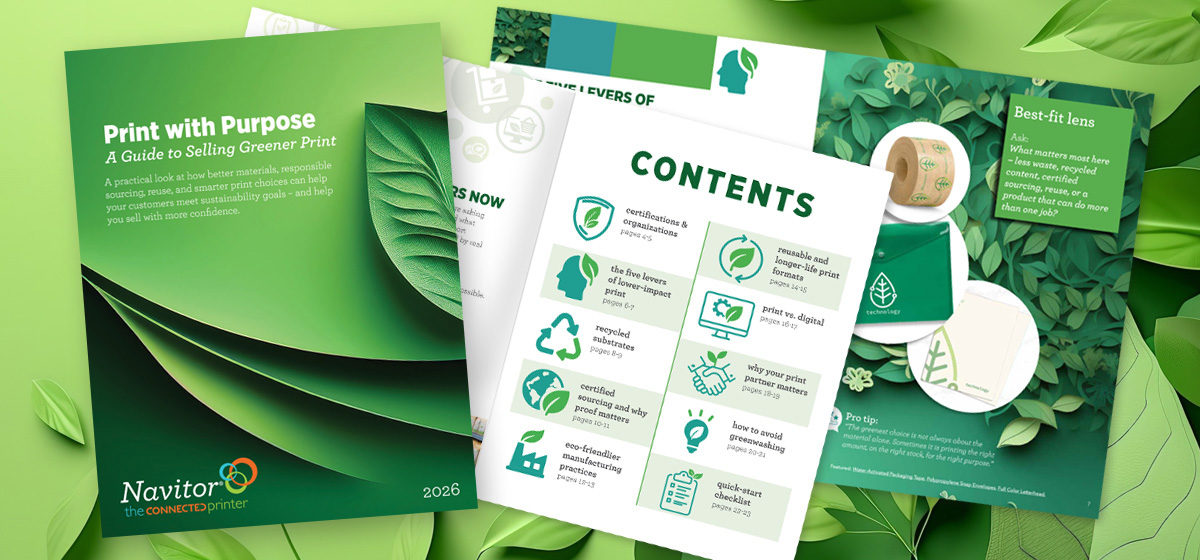
That’s the big idea behind Print with Purpose – A Guide to Selling Greener Print. It was created to help distributors and resellers talk about sustainability in a way that is practical, credible, and actually useful. Not vague. Not preachy. Not one more piece of content telling people to “go green” as if that explains anything.
Because here’s the thing: most customers are not asking for perfection. They’re asking for better choices, less waste, and a supplier story they can trust.
That is a very different conversation. And it is a much more sellable one.

First, let’s clear something up: print is not the problem
Wasteful print is the problem.
That distinction matters because a lot of sustainability talk gets flattened into a cartoon version of reality. Paper bad. Screens good. Case closed. But the real world is a little more complex than that, and your customers know it.
Digital has environmental impacts too. Devices take raw materials. Data centers use electricity. Infrastructure has a footprint. Meanwhile, print is not automatically wasteful just because it is physical. The smarter question is not “print or digital?” It is “what mix creates the least waste and the most value for the job?”
That shift alone makes the conversation more honest.
It also makes you more helpful.
Instead of forcing customers into a false choice, you can help them think through quantity, lifespan, audience, format, and whether the piece is likely to be used once, reused often, or forgotten in a conference tote by lunchtime. That is not only better sustainability guidance. It is better sales guidance.
A postcard with a QR code. A brochure that stays on someone’s desk. Packaging that helps the product and carries the message. A direct mail piece printed in the right quantity on recycled stock. These are not relics of a reckless past. They are tools. The goal is to use the right ones on purpose.
The five levers are where the real conversation starts
One of the strongest parts of our new guide is also one of the simplest: lower-impact print usually comes from a smarter combination of choices, not one magical material that solves everything.
There are five levers:
- Use less.
- Choose better materials.
- Print only what is needed.
- Favor reuse where possible.
- Work with suppliers that are responsible in sourcing and practices.
That framework is useful because it gets everyone out of the weeds fast.
A customer may come in asking for “eco-friendly print,” which is usually code for “I care, but I do not have time to become a packaging scientist.” What they often mean is one or more of the following: recyclable, recycled content, responsibly made, reusable when possible, less waste, and longer-lasting.
That gives you somewhere real to go.
Maybe the best answer is recycled-content paper. Maybe it is a shorter run. Maybe it is a more durable product that gets used longer. Maybe it is a product that does more than one job. Maybe it is simply ordering the right amount instead of flooding a closet with leftovers that become expensive guilt six months later.
The point is: greener print is usually a decision stack. Not a halo.

Recycled substrates are often the easiest place to begin
When a customer needs something printed, recycled-content paper is one of the simplest first steps. It reduces virgin fiber demand, supports circular material use, and feels familiar enough that it does not require a 14-slide internal alignment deck to get approved.
That matters.
The easiest yes is often the most valuable one because it gets the conversation moving. And for a lot of everyday print applications, recycled-content paper is a practical lower-impact upgrade that customers can understand quickly and support confidently.
It also helps to retire one old assumption: recycled does not automatically mean rough, dull, or lower quality. The right stock depends on the use case, not outdated folklore from somebody’s 2009 copier trauma.
This is where product connections become useful, too.
A greener print conversation does not need to stay abstract. It can connect directly to relevant products and applications, from Terraboard® Envelopes to Yard Signs, Engraved Badges, and Wall or Desk Signs, depending on the customer’s goals and the setting.
That is how thought leadership starts earning its keep. It doesn’t just inform. It helps someone decide what to do next.

Responsible sourcing matters
For some customers, recycled content is enough. For others, the bigger issue is where the fiber came from and whether the sourcing can be verified. That is where certification becomes more than a logo. It becomes a trust signal.
When a customer has procurement requirements, ESG expectations, brand standards, or concerns tied to responsible forestry for example, verified sourcing gives you a much stronger answer than “we believe this is a better option.” It lets you point to third-party standards and documented practices instead of hoping the room enjoys your confidence.
These are the ways to move a conversation from general intent to supportable claims.
It also sharpens your language.
Not “totally green.”
Not “guilt-free paper.”
Not “fully sustainable.”
Better: responsibly sourced, recycled-content options, greener print, and in some cases: verified sourcing.
That may sound like a small distinction, but it is the difference between sounding credible and sounding like an over-promiser.
And again, there is a practical sales angle here. Responsible sourcing can be especially relevant when you are talking about products like Business Cards, Postcards, and Labels where material choice really matters.
Yep. The material matters. And the manufacturing story matters too.
A lot of sustainability conversations stop at the substrate.
They should not.
Customers increasingly care not just about what something is made from, but how it is made, how much waste is created in the process, and whether the supplier has actual process discipline behind the scenes.
That includes things like lower-waste production methods, right-sized runs that reduce obsolete inventory, recycling production scrap, lower-VOC process choices, and sourcing standards that strengthen the story behind the final product.
This is where your print partner starts to matter a lot more than people think.
Because customers do not just need products. They need answers.
If you can point to recycled-content options, reusable formats, U.S.-made options where domestic sourcing matters, and manufacturing practices that support a more credible story, you are in a very different position than someone offering generic print with a green adjective taped to it.
And that story can connect to real applications: Decals, Folded Cartons, Note Pads, and other products where the sustainability conversation is about more than the face stock.

Reuse is one of the smartest, least flashy sustainability moves available
Some of the best lower-impact print choices are not about recyclability first. They are about longevity.
In other words: reuse beats one-and-done.
That can mean reusable Totes and PolyWeave® Bags. Sign systems with replaceable graphics. Durable Folders and Holders. Badge products that do not need constant replacement. Even versatile printed pieces like Postcards and Brochures that can serve as direct mail, package inserts, and counter handouts depending on how they are designed.
This is one of the more practical angles in the guide because it helps you move past the idea that sustainability is only about raw materials. Sometimes the greener choice is simply the one that stays useful longer.
That is a strong sales story.
A product with longer life can reduce replacement frequency. A multi-use format can reduce waste. A more thoughtful design can keep a piece from becoming outdated the minute a date changes or an offer expires.
And customers understand that immediately, because it aligns with the most universal sustainability principle of all: do not make unnecessary trash.
Not exactly poetry, but extremely effective.

This is also how you avoid greenwashing
The guide makes an important point here: sustainability claims can help a sale, or create risk. The strongest approach is to say what you can support clearly and specifically.
That means avoiding broad claims like carbon neutral, fully sustainable, eco-safe, or zero waste unless you can truly back them up in context. It means preferring specific claims like made with recycled content, printed on FSC-certified stock, designed for reuse, recyclable where accepted, or produced with lower-VOC ink technology.
- Specific beats sweeping.
- Proof beats adjectives.
- Qualified language beats absolute language.
That is not just safer. It is better communication.
It is also better selling because customers can tell when a claim has bones and when it is mostly decorative.
The real win: you do not need to be a sustainability expert to be useful
This may be the most encouraging part of the whole conversation.
You do not need to become the world’s leading authority on paper fiber, adhesives, inks, forestry systems, packaging recovery, and the emotional life of corrugated substrates.
You need a short set of smart questions and a supplier who can help you answer them.
- Ask what matters most: less waste, recycled content, USA-sourcing, reuse, or easier recycling.
- Ask whether the piece is short-term, long-term, or repeat use.
- Ask whether the quantity can be reduced or right-sized.
- Ask whether a durable or reusable format makes more sense.
- Ask whether the supplier story supports the claim.
That is not complicated. It is disciplined.
And that discipline is what turns you into a trusted advisor instead of a person forwarding PDFs with “thoughts?” in the email body.

Why we wrote this guide
Print with Purpose exists because the sustainability conversation in print needs more practicality, more honesty, and fewer empty claims. It is designed to help resellers and distributors talk about greener print with confidence, connect the conversation to real product options, and guide customers toward choices that are better suited to their goals.
It covers the proof points, the language, the levers, the product angles, and the questions worth asking. It gives you a clearer way to talk about recycled substrates, responsible sourcing, eco-friendlier practices, reusable formats, and the real relationship between print and digital.
In plain English: it helps you sell greener print without sounding vague, defensive, or accidentally ridiculous.
That is useful.
And useful wins.
Ready to make the conversation better?
If your customers are asking tougher sustainability questions, this guide will help you answer them with more clarity and more confidence.
Download Print with Purpose – A Guide to Selling Greener Print and get practical guidance on how to talk about lower-impact print choices, stronger sourcing stories, reuse, waste reduction, and product options that support the conversation.
 About Julie Carlson-Kulla