
Frequency vs volume – and why you want both
Repeat revenue doesn’t come from luck. It comes from choosing print categories that naturally come back around – then giving customers a reason (and a simple path) to reorder without starting from scratch every time.
Here’s the useful distinction:
Reorder frequency is how often customers return.
Unit volume is how big the typical order is when they do.
Both matter, because you sell them differently. Frequency keeps your pipeline steady. Volume makes your month.
The four scenarios that drive repeat purchasing
Most repeat orders show up because of one of these patterns:
- Consumption-based products (they get used up and need replenishing)
- Fast-changing content (SKUs change, seasons change, compliance changes)
- Operational dependency (the workflow relies on it)
- Programmatic marketing (recurring campaigns, multi-location needs)
If you can connect a product to one of those, you can build a reorder engine around it – meaning the next order feels less like “starting over” and more like “running the play.”

Reorder frequency ranking (most repeat to least repeat)
Here’s the cheat sheet: which categories come back most often (and why).
- Labels – ongoing consumption + frequent changes (new SKUs, seasonal versions, compliance updates, launches, packaging refreshes)
- Envelopes – steady replenishment for shipping, billing, notices, fundraising, recurring communications
- Checks & Forms – replenishment where still used + periodic security refresh needs and governance controls
- Marketing Materials – high repeat when positioned as a program (campaigns, events, monthly direct mail, multi-location refreshes)
- Signs & Banners – tends to repeat in cycles and projects (events, seasonal resets, compliance and wayfinding updates)
- Business Cards – repeat tied to staffing changes and rebrands
- Stamps & Daters – often one-time per role/process, then occasional adds/updates
- Folders – event-driven unless standardized into onboarding/sales kit programs
A quick way to use this list: if the product gets consumed, changes often, or props up a daily workflow, you’re not “hoping” for a reorder. You’re building for one.
Typical unit volume ranking (highest units per order to lowest)
This is where a lot of resellers get tripped up: some categories don’t reorder constantly, but when they do, the ticket is strong.
- Labels – often ordered in large quantities because they’re consumed continuously and applied per unit, per shipment, or per SKU
- Envelopes – often ordered in the thousands for mailing programs, shipping operations, recurring communications
- Checks & Forms – frequently ordered by the box, case, or continuous runs
- Marketing Materials – wide range; often 500 to tens of thousands depending on campaign and distribution model
- Business Cards – batches per employee/location; sometimes consolidated across teams
- Signs & Banners – lower unit counts but higher ticket per piece
- Folders – hundreds to low thousands unless part of a standardized program
- Stamps & Daters – low unit counts per order
If you only chase high-frequency categories, you can end up busy but underpaid. If you only chase big-ticket categories, you can end up with gaps. The goal is a mix that keeps orders coming in and margins healthy.

How to build the engine (a simple reseller playbook)
- Lead with an operational item (repeat orders)
Labels, envelopes, forms, stamps and daters are easier to justify because they support daily operations. The “yes” tends to come faster because the customer already needs them to function. - Turn one order into a program
Instead of selling a one-off job, sell the cadence: a refresh cycle, a quarterly kit, a multi-location standard, or a versioned set. You’re not adding complexity – you’re adding predictability. When possible, align follow-up outreach to the customer’s likely reorder cycle so they can replenish before the order turns urgent. - Sell the system, not the piece
Margin improves when you specify materials, finishes, security needs, governance, and the reordering process. Customers don’t just buy print – they buy fewer mistakes, fewer back-and-forth emails, and less scrambling the next time. - Stay ahead of the reorder
If a customer tends to reorder every 30, 60, or 90 days, build that timing into your outreach plan. A quick check-in before they run low helps prevent last-minute “ASAP” orders, keeps the process smoother for both sides, and reinforces your value as a proactive partner. - Make reordering super easy for larger accounts
Company eStores centralize approved items and simplify reordering, which drives repeat orders and helps protect margin. When reordering is simple, customers reorder more – and they’re less tempted to price-shop every single time.
If you want one category to start with: labels and envelopes are the most consistent engines because they’re consumed and replenished.
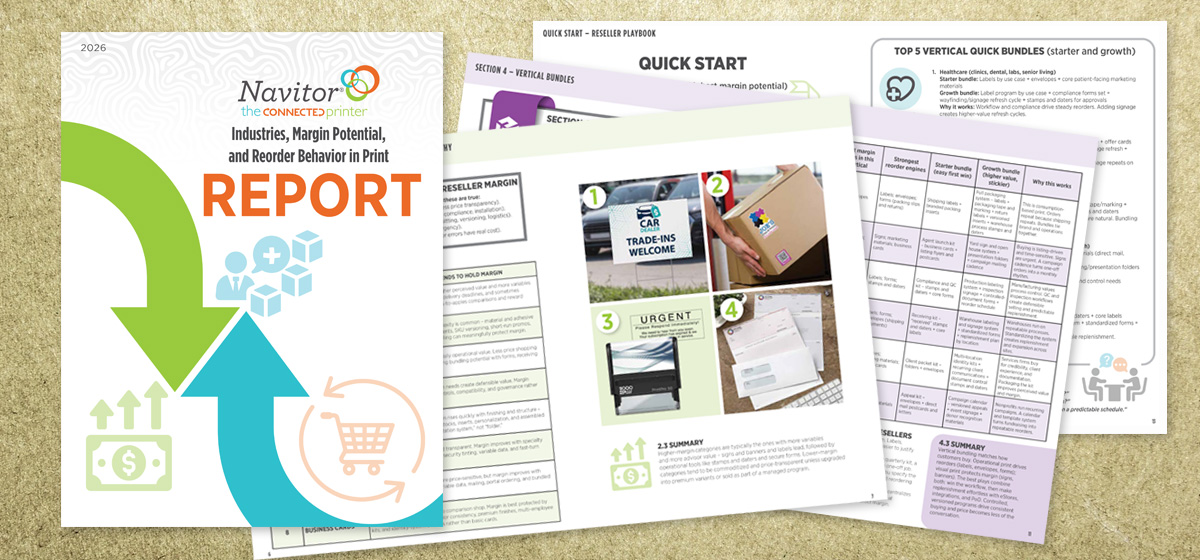
Want the full breakdown?
Get the complete Industries, Margin Potential, and Reorder Behavior in Print report for the full industry-by-product map, margin rankings, reorder insights, and vertical bundle playbooks – designed to help you prioritize what to sell first, what to do next, and what has the most potential to turn into repeatable programs.
 About Julie Carlson-Kulla