Doing More With Less: Creating Great Minimalist Design

do more with less minimalism for personalized print typographyMinimalism has been on trend for some time, and if your customers come to you to ask for your design advice you want to create something eye catching. If what they’re looking for is minimalism, you need to ensure that your design does more with less. Here are our tips for achieving great minimalist design.

Highlight What’s Most Important
Minimalist design relies on choosing only the most important details and leaving the rest behind. If you’re creating a design for your customers, be sure that they pick the information that’s essential. For event invitations, that’s the information necessary for RSVPing and attending. For a business card, that’s your customer’s essential contact information. Use those details as the foundation of the design.

And stick to what’s most important in terms of color, too! Focus on your customer’s brand colors or the colors for their event to ensure that their minimalist design contributes to a cohesive overall look.

If you’re looking for some design inspiration, check out this post from 1st Web Designer to look at some eyecatching minimalist business cards.

Embrace the Unexpected Detail
Sometimes, an unexpected detail is what you need to make minimalism really work for your customer’s print order. A touch of spot gloss or raised print can add unexpected texture. A heavyweight stock can catch attention immediately. A pop of bright, branded color in an otherwise muted business card will stand out all the more because of the minimalist design.

Choose Just the Right Stock
Because minimalist design is focused on only the most important details, your customer’s stock choice is even more important. Minimal designs let the space around the text do much of the talking—and that can make an impact that’s anything but minimal! Minimalist designs allow the texture of the stock to take center stage, whether the stock is smooth and sleek or features a subtle texture with handmade appeal.

Stock can also be the source of those unexpected details I mentioned before. A subtle shimmer from a pearlized stock adds a luminous touch. An extra thick stock has a surprising heft when held. And for an additional pop of color, consider color core stock.

Consider The Print Process
Minimalist design is also a chance for your customers to use print processes that add an extra touch of professionalism to their design. Full color print is a great option for many customers, but when your customers are interested in minimalist design they should consider the many other options available to them.

Thermography is a great place to start. Whether paired with full color print or spot color, thermography adds depth and texture to your customer’s design. That texture can add a lot of interest to their print piece.

Speaking of depth, for a truly extraordinary finishing touch, consider enhanced finishes. Spot gloss and raised spot gloss can be used to enhance your customer’s minimalist design or on their own for a subtle, shiny look. Raised foil creates a classic metallic look with style.

Do your customers love the look of minimalism? What details are their favorites? We’d love to see you join the conversation in the comments below.
Print to Add Polish to Nonprofit Fundraisers

Nonprofits of all sorts will soon be hosting the last outdoor fundraisers of the year, and just as soon they will be preparing for the events they host at the end of the year. When they’re planning their events, they should also be planning the print that adds a great finishing touch to their fundraisers. Here are our choices for the print pieces that will add profit to your customer’s next nonprofit fundraiser.

Posters
Are your customers trying to get the word out to a wider audience? Posters could be the best way to raise interest in their community events! And with a variety of quantities available, posters could also be a colorful addition to event promotion even in smaller communities.

Announcements and Postcards
Some of your customers’ events focus on previous donors or top donors, and announcements and postcards are a great way to add polish to those event invitations. Choose postcards for a more informal feel, or use announcements to make the occasion feel a little extra special.

Brochures, Rack Cards and Sales Sheets
Whether your customer wants to include them with a mailing or wants a piece to show donors what their gifts will be doing, informational pieces are an essential way to get the word out about the good work that they do. Brochures, rack cards, and sales sheets are classic pieces that can include text to show off essential statistics or photographs that highlight the people who benefit from a nonprofit’s work.

Event Tickets
If your customer is hosting a raffle or fundraising event, event tickets are essential! These tickets feature practical details like perforated ends for easy raffle use and numbering to make it easy to keep track of attendees. Even better, when your customer chooses full color print they can help make their nonprofit’s branding more memorable.

Folders
Whether it’s organizing instructions for volunteers, putting together forms and information for donors, or keeping documents organized afterward, branded folders are a good way to keep organized. As a bonus, using branded folders is a good way to add that extra touch of professional polish to every document.

Badges
Speaking of event volunteers, badges are a great way to show which people at your customer’s event are working and which are simply attending. Choose labels as temporary name tags for events with a lot of short-term volunteers, or consider window badges, chalk badges or erasable badges  for flexible badges that can be used at event after event.

Banners, Signs and Other Décor
Once your customers are actually at their event, indoors or out, it’s time to personalize the space. Banners are a great fit for events indoors or out, adding a splash of color in your customer’s choice of a variety of styles. Freestanding a-frame signage can guide attendees through buildings, personalize stages and accent sidewalks outside outdoor event venues.

Do you work with customers in the nonprofit sector? Which print products are their favorites? We’d love to see you join the conversation in the comments below.

Bringing in a Heavyweight: Navigating Paper Weight and Thickness

When your customer is creating a print piece, often their stock choices are one of the biggest factors in how that project fits into their budget. With stocks labeled with both points and pounds, though, it can be tricky to decode what these labels mean. Luckily, we’re here to help! Here is a little advice on navigating lightweight stocks, heavyweight stocks, and everything in between!

Pound vs. Point
Two of the most common measurements for paper are pound (lb.) and point (pt.), but it can be challenging to know what this stock information means. What really makes these measurements difficult to navigate is that they are literally measuring different aspects of paper.

Pound is a measurement of how much a one ream of a paper stock weighs; weights range from 20 to 80 pounds for bond paper and 50 to 140 pounds for card stock. Point is a measurement of the paper’s thickness, with each pt. equal to .001 inch—14 pt. paper, for example, measures in at .014 inches thick.

With both of these measurements, though, you can be sure of one very important thing: the bigger the number, the more heft the stock will have.

How Do These Stocks Measure Up?
Unfortunately, it can be hard to match up thicknesses and weights because the measurements simply aren’t easy to translate. For example, 12 pt. cardstock weighs in at approximately 100 lb., but they aren’t exactly the same thickness. Your best bet is to focus on the type of paper first and the weight or thickness afterward.

This confusing set of measurements also means that your customers might have a hard time visualizing the stock thickness when they’re just reading numbers. After all, unless they are looking at stocks that are both measured by weight, the comparison is a challenge. That’s part of why swatch books are so important to have on hand when you’re making a sales pitch—they allow for easy stock comparisons.

Keep an Eye Out for New Heavyweight Champions
We know that many customers are looking for heavier paper options—that’s why we’ve got exciting new stock options coming soon! Keep an eye on your inbox for news about new stock options in a variety of different weights. And, if you’re not signed up to get Navitor’s emails, take a moment to sign up or update your email preferences.

Do you have any other questions about how to navigate stock choices? We’d love to see you join the conversation in the comments below.

Perfect Print for Real Estate

Whether you’re working with a small realtor or a large company, print is an essential part of their repertoire of sales tools! Print pieces add professionalism to their office, help bring together open house events, and more. Here are our top suggestions for print pieces perfect for the real estate market.

Signage
With versatile full color print, different styles to suit different budgets, and a freestanding style that makes them easy to display in front of houses, yard signs are a classic print piece for the real estate market for a reason! Full color plastic yard signs are a lightweight and eyecatching option that your customer is sure to love. If your customer wants to make a bigger investment in their signage, on the other hand, they should consider full color metal yards signs; these durable signs are easy to reuse time and again.

Business Cards
Another business classic that real estate professionals should keep on hand is a business card. They should particularly look into including realtor photos on their business cards because it is one more way to reinforce the personal connection that realtors build with home buyers.

Folders
No matter how many homes are on a buyer’s list, it can be hard to keep their information straight. Offering them a branded folder is a great way to keep that information organized and to add a polished finishing touch to the home buying experience. Branded folders can also be used to hold paperwork, create welcome packets to be given at closing, or to hold files in the office with professional polish.

Promotional Products
Promotional products are an ideal way for your customers to get the word out about their business. Your customers in the real estate market can attach key fobs to keys at closing, give business card magnets to remind new homeowners of their realtor’s contact information, and hand out a variety of other promotional products at community events to connect with new buyers. They can also create personalized napkins perfect for adding a branded touch to any refreshments offered at an open house.

Labels
In addition to more traditional uses like address labels and name labels, labels are also a popular addition to open house events. Use labels to personalize water bottles at the refreshment table, seal paperwork, and more.

And this only scratches the surface of what print can do for the real estate market. Want more ideas? Consider requesting a copy of our property management vertical market kit for your next sales meeting!

Are there any other products that you would recommend for real estate? We’d love to see you join the conversation in the comments below.

Boost Summer Sales for Small Business

Are you looking for a way to boost your sales this summer? We’ve got news for you! The latest of our vertical market sales kits is here, giving you a chance to speak directly to the print needs of small businesses. Here’s what you need to know about this new kit.

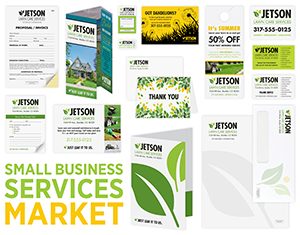
small business kit brochure, business cards, announcements, letterhead, forms, postcards, announcements

What’s In It?
We’ve created this kit around a lawn care business, and all of the products are hand-picked for that market. Practical pieces like business cards, forms, and letterhead are just the start. “Thank you” notes can help build rapport with customers at the end of the season, brochures are a great way to inform prospective customers of new services, and other pieces like Post-it® Notes and door hangers make great leave-behinds if your customer is going door-to-door to drum up business.

These products might be tailored for lawn care, but they’re a great fit for a wide variety of small businesses looking to give a boost to their marketing strategy. Use the kit as an example of how your customer could create a complete print suite no matter what market they’re working in.

How Can You Use It?
Ready to put this sales kit to work? Be sure to bring it with you when you meet with potential customers, especially if you work often with small businesses. It’s also important to keep the samples within reach for when customers walk into your storefront, because you never know when a small business owner will reach out to you.

These kits can be used for much more than samples, though. They are also a great way to highlight cross-selling opportunities. Did your customer come to you for letterhead and business cards to stock up for the summer season, for example? This kit will show them how they could create other print pieces to give their small business an additional boost.

Ready for the Summer Slump
With so many people heading out on vacation, summer can be a slow season. That’s why we are debuting this kit now. A new sales tool for reaching out to a new market could help you connect with new customers even during a slow season.

Best of all, this new sales kit is available free of charge. Simply contact your customer care team to request yours or visit our website to request a kit online.

What do you think of this new sales kit? We’d love to see you join the conversation in the comments below.

The Importance of a Well-Coordinated Stationery Suite

Your customers come to you for a lot of different reasons. Maybe they need business cards for an upcoming event. Maybe they have to create a brochure for a new product. Maybe they want folders to keep organized at their business. However, if your customers are ordering their stationery pieces individually, they might not be taking advantage of the benefits that can come from coordinating their print pieces with each other.

Make Their Business Look More Put-Together
This is the biggest reason for your customers to coordinate their print pieces. When their print pieces look coordinated, it makes their entire business look a little more polished and organized by extension. This starts with their more traditional pieces, of course—a well-matched stationery set is the foundation of professional corporate communications.

Your customer can also extend this idea to other pieces. From keeping offices organized to presenting ideas to customers, branded folders can add a special touch to your customer’s print order. When the time comes for your customers to send out announcements for company news or invitations for their next big event, creating announcements that coordinate with their existing stationery can be a great way of ensuring the event feels connected to your customer’s brand. And when your customer matches their brochuressales sheets, and rack cards to their other print pieces, it will make sure your customer’s brand is top of mind when their clients think of the new products and services that those print pieces promoted.

Create the Right Mood with Every Print Piece
When your customer coordinates all of their print pieces, it ensures that every piece creates the right feel. After all, once your customer has chosen a business card stock that conveys quality or a print process that creates just the right look for their brand, it’s easy to create that same feel by matching other pieces to that business card.

That doesn’t mean they all have to look exactly alike, though. By using an accent color, on the other hand, your customer’s stationery suite will continue to look cohesive but have a more varied, creative look. This is an ideal option for customers who want to convey a lively, friendly, or artistic personality with their print pieces.

Make Your Customer’s Brand Instantly Recognizable
The more your customer’s brand is seen, the bigger the benefits for their business. This means that every piece of print that they send out—from the branded business envelope that holds an invoice to the business card that accompanies a sales representative to an official meeting—is a chance for one more impression. Not only does this make your customer’s brand more recognizable, it keeps their brand top of mind for their clients.

What are your customer’s favorite print pieces? We’d love to see you join the conversation in the comments below.

Added Professional Print Touches for the New Year

Whether your customer is updating their existing print order or creating something entirely new, the New Year is a good time for them to add a bit of extra polish and professionalism to their suite of stationery products. How can they do that? Here are our four tips.

1. Coordinate
Nothing says “You are in good hands” quite like a well-put-together appearance. From employee dress to consistent signage, your customer has probably considered this already, but they might not have considered the importance of coordinating their image across their print pieces, too.

That doesn’t mean that everything has to match exactly, though. The design they print on white letterhead for everyday use, for example, could feel more stately on an ivory stock. And speaking of ways to make designs feel consistent without making them match exactly…

2. Let Brand Colors Take Center Stage
Whether or not your customer wants to put their logo on a given print piece, using their brand colors for every piece is a good way to make every print piece they use feel like a cohesive whole. For some pieces your customer could highlight their logo, but others could simply feature that logo’s colors to create a different look that still connects back to their brand.

3. Don’t Be Afraid to Get Creative
Sometimes changing things up is a great way to pull together a more creative set of print pieces. Does your customer have an abstract or geometric logo? Consider printing it very light across their letterhead for the look of a watermark or letting it extend beyond the cut edge of their business card for a creative accent. Does your customer usually use their logo as the central design in their print—except in one photo-heavy brochure? Consider using that logo as an accent or highlighting it on the back of the brochure alongside your customer’s contact information.

This creativity doesn’t just add visual interest—it allows your customer to be more flexible with their print pieces. After all, with a little bit of flexibility in their brand look, they can create a wider variety of designs for their print.

4. Consider Texture
One way to bring together your customer’s print pieces with style is to use only one or two stock textures throughout their print order. Using the same stock to unify your customer’s business cards, letterhead, and stationery envelopes is a great way to give everything a consistent feel.

And, for additional polish, Navitor offers CLASSIC® Linen and Laid Papers. Not only do these stocks provide a subtle texture that will add a touch of elegant appeal, but the CLASSIC® brand is one that your customers can rely on. Choose linen papers for a cloth-like texture and laid for a handcrafted feel. To learn more about these stock textures, check out the Neenah website for more information on CLASSIC® Linen and CLASSIC® Laid.

How do you help your customers create a polished print order? Do you help them coordinate their print pieces? We’d love to see your tips in the comments below.