Which Envelope is Right For Your Customer?

When your customer is creating a mailing, the envelope it’s sent in will be the recipient’s first impression—they want it to be perfect! That means not only creating the right design but choosing the right envelope for the job. So, which envelope is the right one for your customer?

How Much Polish Does Their Mailing Need?
Finding an envelope to match the feeling of your customer’s mailing is essential. Stationery envelopes are designed to accompany letterhead, and come in stocks to match. They are good for communications that need an additional bit of professional polish, like official company letters or letters to important clients.

Business envelopes, on the other hand are a good option for everyday use in mailing invoices, account statements, and other informational pieces.

And if your customer is looking for a way to send catalogs and other oversized documents, mailing envelopes create a similar look to business envelopes but are made in larger sizes to suit those oversized contents.

Big or Small?
When your customer is sending a large mailing or an informational piece, they might want to consider the size of that mailing piece. Smaller pieces like brochures or rack cards are a perfect fit for business envelopes. Even better than the perfect fit, a branded envelope is a great way to add a bit more professional polish to the mailing piece and another chance to incorporate the logo for an added boost to brand recognition.

However, if your customers aren’t familiar with envelope sizes, you might want to review the options with your customer: #6 ¾ (3 5/8”x 6 ½”), #9 (3 7/8”x8 7/8”) and #10 (4 1/8”x 9½”). Our stationery envelopes come standard in the #10 size.

On the other hand, big documents like catalogs or booklets could do with a larger envelope, and we offer those, too! Choose from 6”x9”, 9”x12”, or 10”x13” to create a mailing envelope sized for your customer’s document.

What Seal Do They Want?
Your customer might not give much thought to their envelope seal options, but they are also an important thing to consider. When they are looking at business envelopes, standard gum flap envelopes are probably most familiar to your customers, using an adhesive that must be moistened before sealing the envelope.

However, standard gum flap envelopes might not be a good choice for customers who are going to be sending many pieces of mail in a short period of time. Peel and seal envelopes use an adhesive strip with a peel-off cover, while flip and seal envelopes require a quick press to seal. Both of these are good options for larger mailings as a result.

How do you determine which envelopes are right for your customers? We’d love to see your recommendations in the comments below.

5 Ways to Use Social Media in Your Business

ways to use social media marketing to boost your personalized print businessIf you use social media in your personal life, you probably know many social media sites for the connections you make with friends and family. However, beyond those baby pictures and news articles you can also find a lot of potential to grow your business! Here are just a few ways that you can use social media to benefit your personalized print business.
1. Join In On A Weekly Hashtag To Emphasize Aspects of Your Business
One good way to keep yourself posting is to get involved in a weekly hashtag like #ThrowbackThursday. Just be sure to pick one that’s a good fit for your business. Does your print business have a long history? The aforementioned #ThrowbackThursday could be a great way to emphasize that history in a more casual way. #MotivationMonday, on the other hand, could be a great way to show off some inspiring print pieces that could motivate your customers to create something extraordinary for their business.

2. Keep Tabs on Your Competition
If your competitors are on social media, you have a unique opportunity ahead of you to keep an eye on what they’re doing. Are your competitors doing something particularly well, like handling customer service concerns in the semi-public setting of social media? Consider how you can improve your skills to better compete with them.

3. Show the More Human Side of Your Business
If you’re looking to create a more personal connection with your customers, social media can be a great way to show the human side of your business to your customers. It can help put a human face on your business whether you make posts to emphasize the employees your customers will meet at your business, use it as a chance to highlight the way your business helps out in the community, or simply interact with your customers in an informal way. This helps connect your customers emotionally with your business.

4. Create Better Customer Service
Many customer service interactions are going online, and having a social media presence allows you to create great customer service interactions in a space where those interactions could positively influence others. Just make sure you have well-prepared responses when you hit the “post” button, and if things start getting heated be ready to take things offline to talk to your customer.

5. Increase Brand Visibility
Brands large and small reach out to new customers on social media, and according to We Are Social the posts on a brand’s Facebook page reach an average of 10.7% more people than their current follower count. That’s a huge opportunity to make your business more visible!

What do you use social media for in your business? We’d love to see you join the conversation in the comments below.

How to Write the Perfect Follow-Up Email

write the perfect follow up sales email for your personalized custom print businessMany times when you meet a new business connection, whether that person is a fellow entrepreneur or a potential customer, it can be a challenge to fit what you need to into that first conversation. You are busy, and so are they.

Enter the follow-up email!

The follow-up email is probably something that you’re already familiar with, and it’s more than merely a formality. It’s a chance to strengthen the business connection you’ve made and to move that conversation forward, so writing the perfect follow-up email is a great way to do that. Here are our steps to writing the perfect follow-up email.

Step 1: Know What You Want to Achieve
A follow-up email can help support a wide variety of different objectives, and knowing what you want to achieve is an essential starting place. Maybe you want to get more information or the answer to a question you’ve had since you last spoke. Maybe you want to arrange a meeting. Maybe you’re working to finalize a sale after your customer mentioned a purchase they wanted to make. Keep that objective in mind as you write.

Step 2: Jog Their Memory
Making sure that you and the recipient of your email are on the same page is essential, so be sure to begin your email with some context. Remind them of who you are and when you last talked, then be sure to remind them which point you are following up on. For example, if you met a prospective customer at a networking event you could say “I just wanted to touch base with you after meeting you last week at the South Central networking event …”

Be ready for them to not remember talking to you, though—and it’s okay if they don’t! If they don’t remember you, using specific details will help ensure that your follow-up doesn’t come across as a cold email technique.

Step 3: Explain Why You’re Emailing
If you had a previous conversation about a specific product in the last step, you might have already done this. If not, be sure to explain why you’re emailing. Did you discuss a product that you’re hoping to sell them? Did you mention that you would be happy to send them a digital catalog? Did they mention an upcoming brand update for which you have products to recommend? Take a moment to mention it.

Step 4: Include a Call to Action
So what’s next? Let your customer know. Ask them if they are interested in more information or whether you can schedule another conversation in the next week.

Step 5: Wrap it Up and Send!
Now that you’ve got the email written, it’s time to sign it and send it. Before you hit that “send” button, though, take a moment to read it through. You want to be sure that the email is short and to the point, and you want to make sure that it comes across as friendly and professional. After you’ve reviewed, send it their way.

How do you ensure that your follow-up emails are perfect? We’d love to see your tips and tricks in the comments below.

Which Informational Print Piece is Right For Your Customer?

Your customer’s spring and summer events are coming fast, and it’s time for them to prepare the print that they need to run tradeshow booths, mailing campaigns, and more. Your customer’s informational pieces—whether brochures, sales sheets, or postcards—need to be ready, and making their information more impactful starts with choosing the right product. Here are just a few of the questions you can ask to learn which informational print piece is best suited to your customer’s need.

How Much Information Do They Have?
The most important thing to consider is the amount of information that your customer wants to share. They might want to create an in-depth list of services available at their business, or they might want to illustrate only the must-know information about a new product. Knowing how much information they will need to include is a good way to narrow their options.

If your customer has a lot of information to share or wants to go into detail about a concept, then they’ll need enough space to let that information breathe. Brochures and sales sheets are a great choice, as are oversized postcards.

On the other hand, if your customer wants to focus on high-level information, a smaller print piece might be a better fit. Postcards, rack cards, and door hangers are a good option for these uses because they offer the same full color style but provide a more compact canvas for your customer’s information.

How Will It Be Distributed?
Once your customer knows what size their piece will need to be, they should consider how they will be distributing this information.

If your customer is going to be handing out the informational pieces in person, they have a lot of flexibility in their options. For settings where they will be handing out a large number of informational pieces—for example, if they want to create a piece for each product—they might want to focus on brochures or rack cards that will be easier to keep organized. If they want one big, splashy print piece, then a sales sheet will make a big impact at tables or booths.

If your customer intends to mail their informational piece, on the other hand, they want to consider how well each piece will mail. A postcard—whether traditionally-sized or oversized—is a great choice that is ready-made for mailing, but pieces like rack cards and trifold brochures are also a great choice because they are well-sized for mailing envelopes.

Do They Want to Get Creative?
We’ve focused mostly on traditional informational pieces, but there are creative options, too! When your customer wants to branch out from these more traditional pieces, there are a number of options they can consider. Magnets are available in a wide variety of different sizes and make a creative alternative to rack cards and sales sheets. For pocket sized informational pieces, consider business cards or trading cards. Door hangers, bookmarks, and announcements are other creative options.

Which informational print pieces do your customers love most? We’d love to see your suggestions in the comments below.

Hosting an Event? Here are 5 Questions to Ask While You’re Planning

Hosting an event can be a great opportunity to show off your business. A lunch and learn can be a good way to educate your customers about new products or important concepts. An evening dinner could be a good way to make your top customers feel important. An open house could help bring in brand new customers and to build word-of-mouth buzz. However, to make your event effective, it’s important to ask yourself these important questions.

1. Who Is Your Target Audience?
Do you want to encourage your top customers to continue using your business? Do you want to create more sales by bringing in prospective customers? Knowing what audience you’re targeting for your event can help focus your plans and ensure that you’re talking to the right people.

2. What Do You Need?
Once you’ve decided on your audience, make a list of everything you’ll need. Do you need to rent a sound system for a lunch and learn? Do you need to send invitations to your customers? Do you need to prepare a talk? Do you need to have catering or book a venue? No matter what type of event you’re hosting, take some time to make a list of everything you need to do before the event can get started.

3. What Else is Going On?
Have you ever scheduled a trip, only to find out that there was a big event going on at the same time? You will want to avoid creating that kind of challenge for your customers, so it’s a good idea to consider other events that might cause an issue. This will help ensure that your customers don’t have to deal with excessive traffic or challenging parking because of another event in your area, and it helps ensure that they won’t have a conflict that prevents them from attending.

This isn’t just local, though. Consider whether there are out-of-town events that your customers will be attending that might make them unavailable for your event. For example, if you work largely with schools then you wouldn’t want to schedule your event on the same weekend as a state education conference.

4. What Are Your Limitations?
You want to host a great event, but it’s important to know what you can or cannot realistically do. If your schedule is tight, hosting an all-day event might be beyond what you’re able to do at the moment. If your budget is tight, a catered lunch might be more challenging than a coffee hour event. If you have a quick turn between planning and the event itself, you might have to keep the guest list small and the event itself simple.

5. How Are You Going to Get People Through the Door?
Getting people to attend an event is all about how you pitch it to them. If you want to bring in the community, marketing in a local paper could be a good option. If you want to bring in your top customers with a feeling of exclusivity, you might want to invest in an announcement to invite them to your event. And for some audiences, an invitation or marketing pitch might not be enough; you might need to offer food or freebies to get them interested. Whatever your audience, it’s good to plan how you will encourage them to be at your event.

Do you plan events at your business? How do you ensure that they are a success? We’d love to see you join the conversation in the comments below.

Create a Great Presentation in Less Time

personalized print sales presentationsYou’ve made it past the initial elevator pitch. Your new customer is interested. You’ve scheduled a meeting. You might be tempted to create a big presentation that will take most of your allotted time.
Then your customer calls. Maybe their day just got a lot busier. Maybe the weather looks like it is going to take a turn and they need to be out the door earlier than expected. Maybe they simply needed to shorten your meeting. It’s time to create a presentation that will pack a lot of sales punch into a limited time frame—and Navitor is here to help! Here are our tips for creating a great presentation when time is tight.

1. Start With What You Know—What Challenge are You Solving?
Whether you’ve had a chance to talk with your customer about the challenges their business is facing or you only know a little bit about the market they do business in, focusing on what need you’re fulfilling is an important way to bring focus to your presentation. If the customer mentioned that they are rebranding, for example, take a moment to discuss how ordering updated stationery pieces can help establish that brand. If they are moving to a new location, talk to them about updating signage. And if you’re going in blind, consider using our vertical market kits as a guide for which print pieces might be a good fit for their market.

2. Get Visual
You know how they say that a picture is worth a thousand words? When you don’t have time for those thousand words, embracing visuals can be a great way to pack more information into the presentation. Wherever you can, use graphs to illustrate data or diagrams to illustrate concepts like bleed. Not only do these visuals help your prospective customers understand the information you’re giving them, but they do so at a glance. And if your customer wants a more detailed discussion of the data you’re sharing, consider having a printout of the full information on hand.

And speaking of visuals…

3. Use Samples to Reinforce Information
Samples can be a good way to show your customers what final printed pieces will look like, and having print pieces to look at can help reinforce the information you’re discussing in your presentation. They are especially important if you’re going into your presentation without having had much contact with your prospective customer—samples can give them a great idea of what you can do.

4. End With a Call to Action
Especially when time is tight, having a clear next step in place is key to keeping the conversation going. Whether you’re going to call them in a week to discuss their needs further or they are going to send you their designs for business cards so that you can place the order, make sure that you end the meeting with a clear next step.

How do you create a great presentation when time is tight? We’d love to see you join the conversation in the comments below.

Effective Marketing Strategies For When Budgets are Tight

There are a lot of ways to approach your marketing strategy. You can lean hard on online marketing. You can advertise on television, on the radio, in magazines or newspapers. But all of these methods can be expensive. So how can you market your business when your budget is tight? Here are some effective—and low-cost—marketing strategies that you can use to get the word out about your business.

Work on your Public Relations
If you can make the news, it can be a powerful way to promote your business without making a big impact on your budget. A news story can help raise your profile in the public eye, and a news story feels more authoritative than an advertisement.

How can you get started? Consider a press release. Even if you only distribute the release to local news outlets, a press release is a good way to spread the word about big news at your business. From new locations to new products, there are a lot of pieces of news that could help you connect to the press. And, if you’re looking to make a splash…

Give Back
Giving back to the community is a great way to create a positive reputation for your business and to make the news. Sponsoring an event like a cancer walk, having a collection jar for the local food shelf at your storefront, or even taking some time as a business to volunteer for a good cause can be a good way to give back and to generate goodwill with customers and prospects.

Use What You Already Have
One of the best ways to save money in your marketing strategy is by using what you already have—and you might have more than you think! When you creatively use your existing resources, you can build a strong foundation for your marketing strategy and make your budget even more effective.

If you have a storefront, you have many promotional possibilities before you. Your storefront’s windows are a place to showcase samples or banners to advertise special offers. Your door and windows are a great place to display your logo and store hours. The sidewalk out front is an opportunity for A-frame signs to bring in walk-in traffic.

Talk to Your Suppliers!
One important thing you already have is your suppliers. From free sales kits and samples to digital resources like catalogs and flyers, your supplier might already offer a variety of pieces you can use in your marketing strategy. Navitor does—and we create new flyers every month!

Use Your Budget for What’s Important
No matter what your budget, saving money by using the previous tips can give you more wiggle room in your budget for more expensive marketing options. For example, using supplier sales tools might allow you to invest the time and money you would have otherwise spent in designing your own flyers in advertisement in a local publication instead.

How do you save money on your marketing budget? We’d love to see your tips and tricks in the comments below.

Quiz: Pens, Pencils, and Promotions By The Numbers

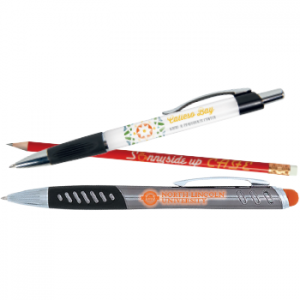
personalized custom promotional pens pencils full color metal lightTake a look at your desktop. If it’s anything like mine, you probably have a cup full of pens, pencils, and markers at the ready for taking notes, signing forms, and more. And chances are that at least some of your pens or pencils will be branded promotional pieces. Your customers might be interested to know just how effective pens and pencils can be at promoting their business.

So, do you know the numbers behind promotional pens and pencils? Take this quiz to find out.

1. Writing utensils like pens and pencils are some of the most effective promotional products around. How many times are pens used every day?
A) 3 to 4 times per day.
B) 1 to 2 times per day.
C) 11 to 12 times per day.
D) 6 to 7 times per day.

2. While writing utensils are lower in cost than many other promotional products, they still have a big presence in the market. Writing utensils make up about how much of promotional products?
A) 5.67%
B) 6.67%
C) 7.67%
D) 8.67%

3. There’s one region of the United States that owns more logoed pens than the average U.S. citizen. Which one?
A) The South
B) The Southwest
C) The East
D) The Midwest

4. Let’s get into demographics. According to a study conducted in the southeastern portion of the United States, who are more likely to own a logoed pen?
A) Democrats
B) Republicans

5. Speaking of demographics, do men or women own more logoed pens?
A) Men
B) Women

6. Of course, the promotional products market is all about value, and that’s about being seen. How much does each impression or viewing of a promotional product cost the company it promotes?
A) 1/20 of a cent
B) 1/10 of a cent
C) 1/5 of a cent
D) 1 cent

7. Let’s go international for the last question! Which of these cities has the highest consumer response to promotional pens?
A) Berlin
B) Mexico City
C) Paris
D) London

ANSWERS:
1) A. Logoed pens are used an average of 3 to 4 times per day throughout their lifetime.
2) C. According to PPAI, pens and pencils amounted to 7.67% of promotional product sales in 2017.
3) D. According to ASI, 68% of consumers in the Midwest own a logoed pen.
4) A. Democrats are more likely to own a logoed pen, with 74% of them owning these pens when compared to 65% of Republicans.
5) B. More women than men own logoed pens in the United States, though the gap is smaller than it was between political parties. 58% of women own logoed pens compared to 54% of men.
6) B. The cost per impression in the United States is less than 1/10 of a cent—that’s a lot of views per penny!
7) D. ASI says that 56% of people in London had received promotional pens in the last 12 months and rated them highly.

How did you do? Did you learn something new about pens and pencils? We’d love to hear about your score in the comments below.

Rising Demand for More Eco-Friendly and Sustainable Labels

Every year, the world produces 1.3 billion tons of waste. That’s a staggering amount, especially when you consider that from 2017-2018, the world produced 745.8 million tons of wheat and 479.8 million tons of rice. As a planet, we produce more garbage than we do wheat and rice combined. Holy landfill! By the year 2100, projections indicate yearly waste generation could reach 4 billion tons. That’s enough garbage to fill Busch Stadium from top to bottom four times a day. It makes one wonder if we won’t be living in space by then to escape all the garbage!

To put things bluntly, we have a garbage crisis on our hands here on the blue and green planet. And every small piece of refuse adds to the landfill plight. Recycling and reduction in waste have become paramount. Sustainability of the planet depends upon coming up with innovative ways to reduce the amount of garbage being sent to landfills. Labels are no exception to this endeavor. Consider the vast number of labels on bottles, cans, boxes, and other disposable products. Label backers contribute to the landfill problem, as does material waste from the creation of label stock. Are we destined to become one large landfill divided by ocean water?

Luckily, there are a growing number of green options today for labels and packaging. All of these options help reduce the impact on our planet, while helping boost sustainability. The job of protecting our planet doesn’t fall squarely on the shoulders of environmentalists. Consumers are looking for options that are eco-friendly and promote sustainability. Curious about label options for eco-conscious companies? Read on.

First, it’s important to consider where the packaging and labels will ultimately end up. Landfills? Compost bins? Recycled? Different stocks and/or adhesives can be chosen depending on the ultimate destination of the packaging and label. For biodegradable packaging, it only makes sense to select a biodegradable label as well. Compostable adhesive labels work well on packaging that is certified compostable. One toss into the compost bin – label and all! These types of labels are becoming more prevalent as the interest in composting rises and the tide slowly turns from single-use plastics.

Earth-minded companies that are committed to using packaging that is recycled are often interested in labels that are the same. Recyclable adhesive labels can be recycled right along with the packaging, and do not have to be removed. This cuts cost, work, and helps drive home branding messages that speak of commitment to recycling.

Newer practices in production allow labels to be created using a reduced amount of materials. Again this help cut waste, which reduces the manufacturing impact on the environment.

At Label Works, we’re committed to broadening our eco-friendly and sustainable label and adhesive options. This includes choosing stocks that come from well-managed forests. This provides environmental, social, and economic benefits. And this doesn’t mean just one or two options. These stocks are all FSC® certified stocks that are smartly sourced with our planet in mind:

  • White Gloss
  • White EDP
  • White Matte Removable
  • White Laser
  • White Laser Removable
  • Direct Thermal
  • White Semi-Gloss
  • 100% Recycled – Produced with 100% Post-Consumer Waste
  • 30% Recycled Semi-Gloss – Produced with 30% Post-Consumer Waste

We also have recycling-compatible adhesives on stocks:

  • 100% Recycled – Meets the TLMI testing protocol RCA LRP 2v5 for recycling compatibility

Offering sustainable label options isn’t where we stop, however. At Label Works, we recycle all cardboard, paper, plastics, and liner waste facility-wide. Our liner waste is shipped to a recycling facility where it is shredded and then burned as fuel at a local facility rather than taking up permanent residence in a landfill.

Want to learn more about ways in which labels have evolved to become more earth-friendly? Contact Label Works to discuss label options that are eco-conscious, while being as impactful as ever.

SOURCES:

Production of Wheat

Production of Husked Rice

5 Print Products Perfect for Retail Locations

It can be easy to think of a storefront in terms of larger print pieces like signage, but signage is really only the beginning of the print possibilities! If your customer works in the retail sphere, they might be missing opportunities to reinforce their brand in smaller ways. Here are five of our favorite print products that are perfect for retail locations.

1. Pens and Pencils
From signing receipts to taking notes, writing utensils will be used a lot at your customer’s retail location, and having a personalized pen or pencil on hand is a great chance to add another touch of brand recognition to customer interactions. Not only are pens and pencils a good addition to the checkout process, they double as great giveaway items when your customer wants to promote their business.

2. Name Badges
Is your customer looking for a way to bring their branding to every customer interaction? Name badges are a good addition to their print order. Not only can name badges be created to match their branding, signage, and more, but they are a good way to bring branding to the table when employees don’t wear uniforms.

3. Plastic Bags
If your customer is looking for a way to add polish to their retail location, there’s nothing better than a personalized printed bag. These bags are a great way to bring your customer’s brand to every purchase. And with full color plastic bags back in our product offering, your customer has even more versatile print options for their personalized bags.

4. Reusable Bags
If your customer wants to encourage their clients to be more ecofriendly, reusable bags are an increasingly popular option that they might want to consider. With a wide variety of tote sizes available, your customer can choose the size that best matches their product selection. Then they can give these bags to top customers or use them to promote their business in the community.

5. Business Cards
Your customer might not immediately think of business cards when they are ordering print for their retail location, but with a little bit of creativity they will find that business cards are a very versatile print piece. They can, of course, leave business cards near their checkout to encourage repeat purchases or tuck a business card into the bag with purchases.

With creativity, your customers could create even more for their business. They could also use business cards to create a punchcard for a simple rewards program—simply choose a lightweight stock for the card and stamp or punch it at the point of purchase. For boutique settings, business cards could be an ideal product tag. For customers who want to make a big splash with big clients, business cards could be a great canvas for a colorful, high quality coupon or referral card. And if your customer works in a store that offers clothing fittings, business cards could be a good way to mark future fitting appointments.

What print products do your customers in retail love? We’d love to see your suggestions in the comments below.