Major Changes Shaking Up the Healthcare Industry

A large part of how we support our distributor partners involves taking into account predicted trends for the upcoming year within a variety of vertical markets. As we look forward to a new year, it is apparent the competition will be fierce and those with solid sales strategies will excel. We’re taking a close look at what big changes this new year brings for healthcare organizations and what that means for our distributors.

Healthcare marketing budgets are up

Out of the main types of healthcare companies in the U.S., including categories like pharmaceutical manufacturers and medical device firms, biotech companies had the highest marketing budgets. Nevertheless, all have increased their marketing spend in the last couple of years. On average, the marketing budgets of healthcare companies in the country grew by almost two million dollars. Great news for our industry is the added fact that in general, the healthcare sector tends to focus more on advertising by way of traditional media rather than digital, at least on a local level. This means more print sales for you.

Healthcare continues to consolidate and run as a business

Many industries have been seriously affected in the last couple of years, while vertical markets like healthcare continue to forge ahead impacted in a very different way. Increased demand, as well as mergers and expansions, have brought marketing opportunities for rebranding, open house events, and other communications and promotions. Loyalty programs, direct mail, and promotional products will be increasingly needed. Print marketing has been deemed the most effective marketing strategy for products and services in the healthcare sector. This is due in large part to how hard it is to convince consumers to trust a brand’s product or service just by reading an online ad. However, studies show that most consumers trust printed material far above digital, especially in the healthcare market. The power of print marketing cannot be overemphasized in this industry.

People are seeking integrated healthcare systems

The alternative healthcare sector provides a variety of health services such as acupuncture, naturopathy and homeopathy, meditation, yoga, massage, and much more. The practitioners in this industry had typically operated private or group practices in their own offices, however, due to the pandemic, industry revenue fell significantly when practitioners were unable to offer in-person services. As restrictions lessen, industry revenue has surged as patients quell their pent-up demand for alternative services. The industry has returned to robust growth and at the same time, more insurance companies and employers have recognized the benefit of covering alternative healthcare.

The forecast

As this expansion continues, more practices are landing in the facilities of others, such as hospitals and medical centers because today’s healthcare consumers are seeking out integrated systems and they want convenience. They want easier access to the services they are looking for, when and where they need them. Demand for alternative healthcare is expected to continue over the next five years as a result of increasingly favorable attitudes toward industry services and favorable demographic trends. In particular, the aging population, facing the mounting incidence of disability that accompanies old age, is expected to bolster demand for alternative services. More importantly, the growing acceptance and expanding coverage of these services will drive industry growth. As consumers look more to integrated healthcare systems — where they also have access to retail, urgent care, primary care, and hospitals — traditional hospital systems and large group practices will feel the pressure to expand their services.

What does this expansion mean for our distributors?

Marketing and advertising is expected to take up a significant chunk of budgets as enterprises must promote their businesses rather than just rely on word of mouth. Having a clear understanding of the most important keys for success for this industry – like creating a stellar reputation, developing a symbiotic relationship with other healthcare providers, educating the wider community and generating a loyal customer base – will help you speak directly to their needs. It is also a great exercise in observing the opportunities for print within each key and aligning products and services to meet your client’s objectives.

The Research Dollop

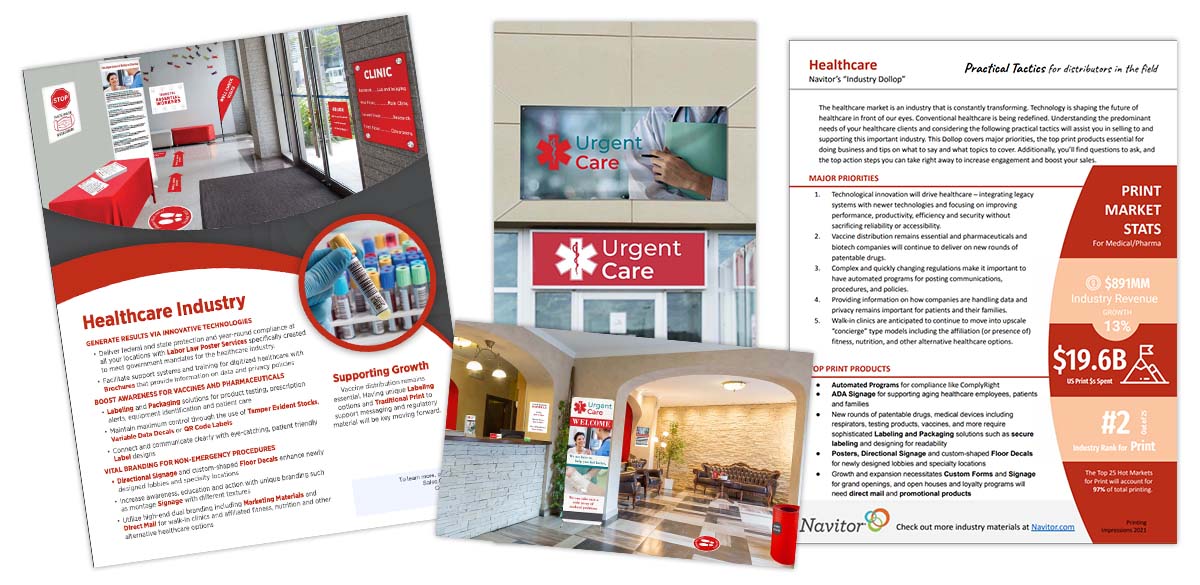
To further expand your familiarity and expertise within the healthcare industry, we’ve created a research dollop for your use. By exploring the predominant needs of the industry and considering the practical sales tactics offered, this educational asset will assist you in either breaking into or further penetrating this worthwhile industry. Taking into account the industry’s major priorities, the most-ordered print products, and reviewing tips on what to say, the healthcare dollop gives you valuable insights and tangible conversation starters. It aligns healthcare marketing objectives with products and services for you to sell to support expanding alternative healthcare, as well as branding opportunities in other growth areas such as non-emergency procedures, and urgent care centers. Additionally, you’ll find questions to ask and the top action steps you can take right away to increase engagement and boost your sales.

The takeaway

Print marketing has had a long-standing alliance with healthcare and it proves to be the best way to stand out in a crowded media landscape. Physical ads and printed pieces have more impact and emotional weight than digital marketing and end up being decisive factors for consumers contemplating healthcare providers. With print marketing, prospective customers can get more details and develop an emotional and subconscious affiliation with the brand. Utilizing various print marketing tactics with all they have to offer is a perfect way for your customers in the healthcare sector to generate new leads and increase brand awareness.

Our newly updated healthcare flyer for the healthcare industry is now available and our healthcare industry dollop has up-to-date information regarding selling to healthcare, designed to help you position yourself as a thought leader and problem solver in this market. For social posts or your website, we have a healthcare social toolkit that you can use to copy, paste and post.

Staying on top of market trends and industry conditions gives us the means to help you make the most of identified opportunities. Rely on us as your go-to resource for thought-leadership and innovation. We’re here to support your efforts in delivering the best customer experiences, giving your customers what they need, and addressing topics important to them.

Program Selling to the Financial Services Industry

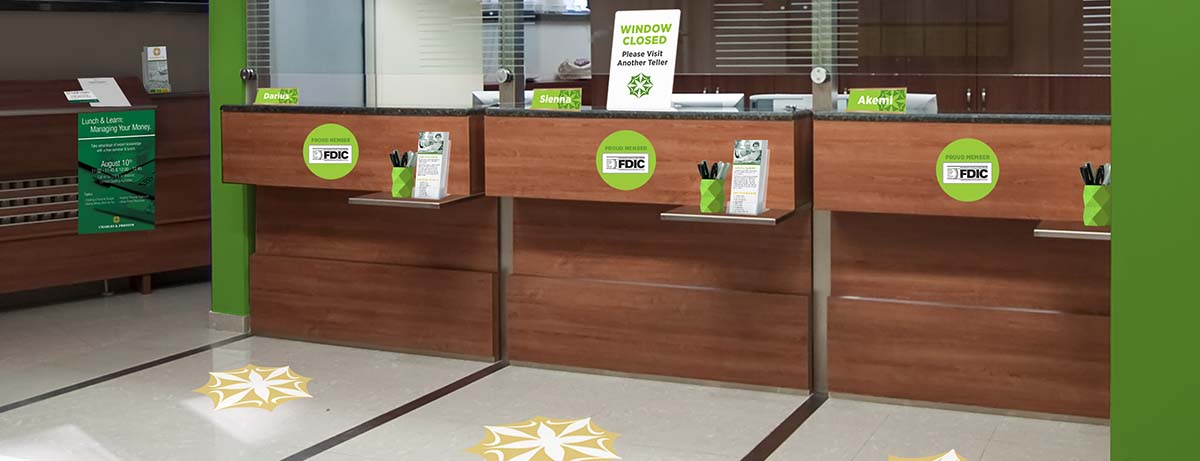
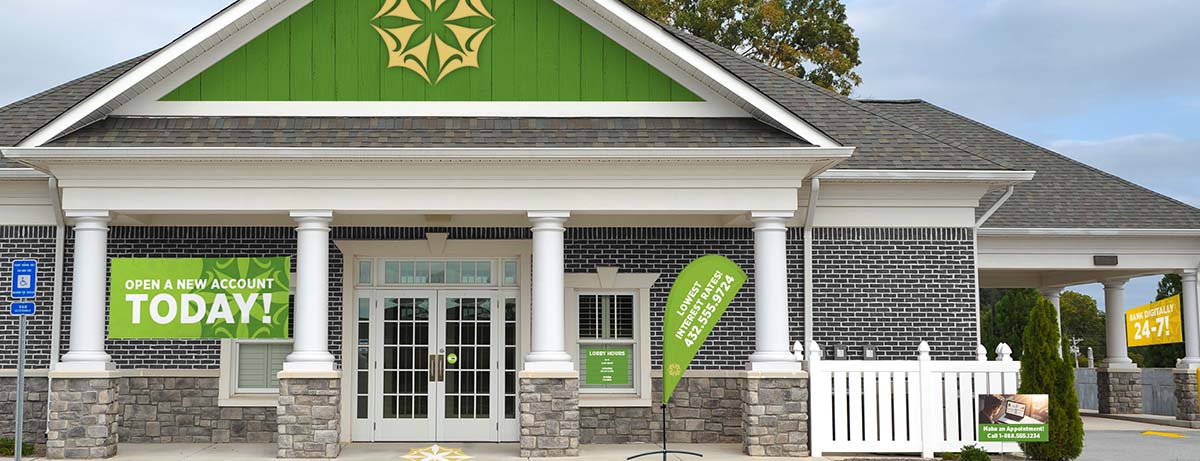
From direct mail outreach to in-branch brochures, and from outdoor and indoor signage to handouts at trade shows and events, banks and credit unions continue to need copious amounts of printed materials. Print communications remain powerful marketing tools for the financial services industry, yet streamlining ordering and maintaining brand cohesiveness between branches prove to be hurdles many have yet to master.

All the feels

Because print advertising connects more on an emotional level with readers than digital, it continues to be the go-to medium of financial services companies. It offers readers a chance to linger over product and service messaging in a way that other channels don’t. Print advertising provides prospects a tangible way to engage with the brand message.

  • Print lasts longer (digital ads disappear in seconds)
  • Print is viewed as more trustworthy
  • Print is cost-effective

However, there is without question a significant focus on online banking, and digital access to banks has increased greatly. Accordingly, mixed marketing such as a postcard with a QR code or Bitly link to online banking will help provide direct access to products and services.

Time to think like a financial services company
What do you suppose keeps their marketing decision-makers up at night? For larger institutions, they may be considering the demand for consistency across multiple branches, indicating the need for a program solution that ensures uniformity in messaging, seamless installation and access to additional products. For medium and small institutions, they may be contemplating local business investments, signifying the need for a collaborator like you to partner with them. They may also be looking to the local chamber of commerce to bring in more opportunities and to demonstrate the value of such investments to the community. For maximum trajectory, think mailing campaigns, vibrant signage, and community canvassing, as well as developing investment guides and infographics depicting top areas of growth.

Here are more ways to get into the minds of your financial services clients:

Trust is numero uno.
Every one of your financial services company clients will tell you that ensuring their customers or members feel trust in their financial institution is priority number one. This includes trusting that both their personal AND financial well-being are being looked after. Refining branch-to-branch and branch-to-member information flows while quickly distributing new collateral based on changing interest rates and economic conditions is paramount to a financial services company’s success. They also lock in that trust by maintaining a positive perception and core position in the community while upholding compliance and regulatory mandates across print.

Renewal and revitalization matter.
More than ever communities are thinking local (shopping, supporting, frequenting) and banks often support “Shop Small” sponsorships or local events to further promote their role in the community. Events require communication efforts, signage, giveaways, apparel and residual marketing products. Special financing, payment forgiveness and small business loans are a few examples of advertising offers that banks and credit unions will consider as an important part of recovery efforts.

Branch distribution is a big deal.
When they roll out a program, financial services companies want their vendors to help coordinate the distribution of their products and may require kitting and project management. Both standardization and compliance are very important across branches, but often your bank and credit union clients don’t have the internal staffing to ensure proper installation and execution. This works to your advantage … with our help, you can really deliver the goods here.

Going online is inevitable.
While digital marketing tactics aren’t as touchy-feely as print and can quite honestly leave bank customers and credit union members cold, online banking is certainly the preferred choice for most, and we don’t see this changing. At the same time, having a local presence is important to a financial services company’s growth. Therefore, maintaining a consistent brand image across all mediums (print, online, signage, promo, apparel, business identity, folders, etc.) is crucial for connecting the digital world to their local community.

A holistic approach

This is where multi-product selling (or program selling) makes its grand entrance. Whether starting small with individual product sales and then building on the offering over time, or introducing a whole suite of cohesively branded products to their financial industry customers, our distributors can really bank on our technology platform designed for program selling. Let’s walk through some case studies that really illustrate the benefit of our solutions:

  1. A large financial institution wanted to deepen relationships between their lending officers and customers by personalizing essential documents. With custom printed Post-it® Note business cards and notecards, the company achieved its marketing objectives without a costly overhaul of existing print collateral. The custom adhesive notes included the lending officer’s contact information and photo, and could be applied to all communications with the customer. As a result, lenders used fewer of their higher-cost business cards, reducing overall print spend. Personalizing generic financial documents with custom branded adhesive cards allowed lending teams to engage with their clients and community.
  2. A distributor just getting started in selling print placed their initial orders manually because they were not very confident with the medium, let alone Navitor.com. Eventually they progressed to placing a couple of orders on Navitor.com and quickly realized just how easy it was to simplify and streamline the ordering process – especially around improving timeliness. As they kept working with their client, they discovered five more locations that were going to need similar branded products, and decided that time/order management could potentially become a bottleneck. We set up a white label ordering platform that their client can order from directly. This program started with a few orders for five-dollar name badges and will likely mature to a five-digit sales growth within a year. The program includes business cards, badges, envelopes, letterhead, presentation folders, decals, labels and more.
  3. Brand control on a large assortment of products was a challenge for one company that faced a surge in requests from their clients looking for ways to mitigate the impact of the pandemic. The need for communication and marketing materials increased exponentially. With the rapid increase, the company realized they needed to lock down brand standards. Working with Navitor on product fulfillment and utilizing our online ordering platform customized to meet the specifics of their organization saved the day. Locations can log on and order their pre-branded business stationery, their new customer kits and the rest of their marketing materials.
  4. Technology integration and brand control were sticking points for one distributor’s large client with 2,000 locations. They were having difficulty maintaining brand standards and controlling expenses since each location was ordering their print ad hoc from various vendors. After the client established their own brand portal to centralize sourcing, it was vital to find a print provider that could integrate quickly with their existing e-store ordering platform. By partnering with Navitor, the distributor was able to spin-up an ordering platform that incorporates brand compliance and efficient ordering while controlling the quality and brand conformity of the end product. In addition, the client has sourced several additional print items Navitor produces, resulting in BIG business for our distributor.

Content you can count on

Our newly updated flyer for the financial services industry is available here, and our industry dollop has up-to-date information regarding selling to financials, designed to help you position yourself as a thought leader and problem solver in this market. For social posts you can copy, paste and post from your social media accounts in order to prompt conversations, click here.

We are keeping our fingers on the pulse of the financial services industry and are working on your behalf to provide useful content and relevant solutions to keep you selling. Staying on top of market trends and industry conditions gives us the means to help you deliver the best customer experiences. To make sure you’re giving your customers what they need and addressing topics important to them, rely on us as your go-to resource for thought leadership and innovation.

Your Buyers Spoke. We Listened.

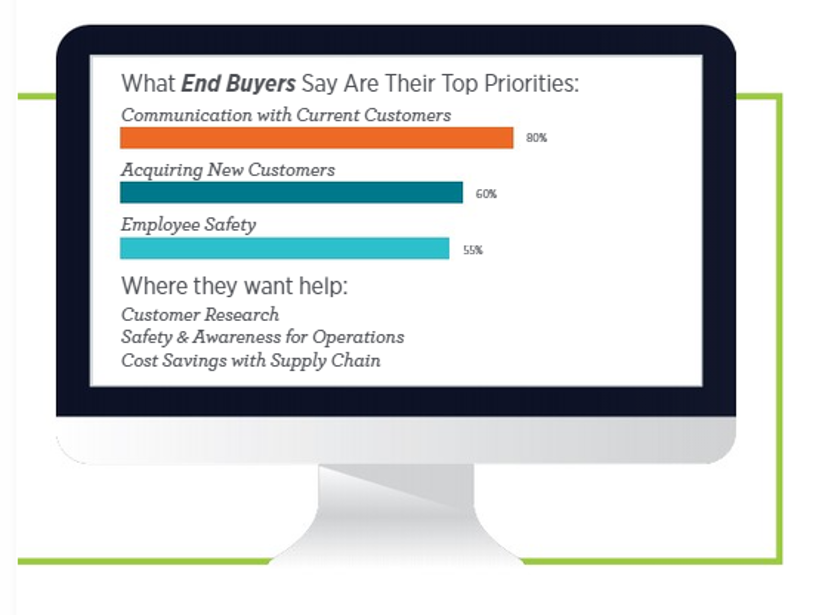
Without a doubt, exploratory market research surveys bring understanding around certain aspects of a target market, allowing for improvement in the quality of decisions. Uncovering attitudes, opinions, beliefs and behaviors nets a glimpse into your buyers’ worlds, and the impact of those insights and feedback can be huge. Helping you set your brand apart from the competition was a driving factor behind our recent end-buyer survey project. We surveyed hundreds of CEOs and Business Owners of small, medium and large companies across the U.S. to get a better sense of their business priorities for the next 6-12 months.

What YOUR Customers Are Saying
The top priority for business recovery in 2021 across all survey responders is communication with current customers. These results validate what we are observing in the marketplace and are further substantiated by upward trends in mailings, and increases in the envelope category, personalized packages, and kitting and fulfillment. Ranking second on the list of priorities is new client acquisition. Employee safety rounds off the top three.

  • For large companies, their top three (in order) are: communication with current customers, technology and eCommerce initiatives, and employee safety. Of least importance to large companies: executing marketing campaigns, then community support / safety and vaccination sponsorship.
  • For small companies, the top three priorities are identical to the overall results: communication with current customers, new client acquisition, and employee safety. Of the least importance to small companies is talent acquisition. Technology and eCommerce initiatives ranked second to last.

Understandably, employee safety was a top-three priority for all respondents, companies big and small. With the year we just had, it makes sense that it is a top priority for businesses out there.

Where End-Buyers Need Support
In ranking where they need the most support in carrying out their short-term objectives, half of all respondents ranked help with customer research as the top need. Safety and awareness for operations and cost-savings within the supply chain tied for second place with 37% of survey-takers ranking each of them as need number two.

  • For large companies, help with customer research fell further down to number four in their needs. They see safety and awareness for operations as where they need support the most, followed by ideas for employee engagement, then technology support. Ideas for employee engagement fell to the bottom of the list for smaller companies and streamlining administrative tasks ranked lowest for larger companies. The interest in cost savings is notable and validates the importance of pitching to larger companies a technology solution that streamlines order flow and eliminates touches.
  • Smaller companies closely aligned with the majority responses, and ranked needing help with customer research as their top choice, followed by cost savings within the supply chain, and then shifting their third to streamlining administrative tasks.

Rating Employee Engagement
In regards to employee engagement, ranking in order from one to five, the survey showed us employee safety lands in the top spot most often (by a large margin), followed by connecting with remote employees, then health and wellness awareness campaigns. At the bottom of the ranking overall was bringing employees back to the office.

  • For large companies, correlating with the masses, 34% ranked employee safety as number one, and connecting with remote employees was voted number one by 31% of responders from that group. 22% of large-company responders chose health and wellness awareness campaigns as the top ranked.
  • For smaller companies, connecting with remote employees nabbed number one most often

Vaccine Support
When asked how their company is supporting COVID-19 vaccination efforts, 70% responded that their company is taking action.

  • 25% noted their company is encouraging employees to get vaccinated and are offering time off, childcare, flexible schedules or information on where to go.
  • 21% answered that their company is supporting COVID-19 vaccination efforts by either following safety guidelines and preventative measures or having employees work remotely.
  • 13% of survey-takers said their companies are facilitating a vaccine clinic or sponsoring free vaccinations. Of that grouping a few noted offering free tests and mentioned their support of recovery efforts in the community.

What Does It Mean to Me?
All this data is powerful – but it’s powerless without the right analysis. What’s a survey without translating the findings into actionable items that drive data-backed strategies? The fact that executing marketing campaigns is a low priority yet customer communication is the top priority gives us some valuable insight. What does this mean for you? When prospecting, make sure to use the language of your customers’ priorities:

  • Say: “Are you looking to improve your customer communications?”
  • Don’t Say: “Are you looking to increase your advertising to customers?”

Editing your pitch in this way shows that you care about what is going on with your customers, and will help you to improve their experience and better serve their needs.

When considering end-buyer top priorities, prepare to discuss ways to execute effective and meaningful communications to current customers.

  • Do: Plan demonstrations to present ideas for new client acquisition campaigns.
  • Do: Promote ways to support their efforts to ensure employee safety through communications, signage and supplies like partitions and hand-sanitizer stations.
  • Do: Update your website and social presence. Find ideas in the Outreach Kit.

Where end-buyers say they need help presents additional opportunities for you.

  • Do: Provide innovative solutions that support their safety and awareness needs, cost-saving ideas, plus original and creative options for employee engagement cover what they are asking for.
  • Do: Provide communications that are relevant to your customers’ industry. Navitor’s free content page for distributors has over 100 pages of ideas, products, text and imagery you can use as your own with your customers.

Because vaccine support efforts are underway, there are opportunities for you to solve some of your customer’s challenges.

  • Do: Outfit sites and help your customers communicate information and guidelines. This will solidify your position as a valuable partner.
  • Do: Supply vaccination locations and clinics with unique products. Check out the list of top products and support materials here.

We’re here for you
Tapping into your buyers’ opinions and insights allowed us to spot common trends and gather pertinent data. This data gives us the means to help you deliver the best customer experiences.

To make sure you’re giving your customers what they need and addressing topics important to them, rely on us as your go-to resource for ideas and innovation. Navitor has a ton of options and ideas and offers free content and marketing collateral for distributors like you that you can use as your own.

7 Days to Successful Prospecting

Let’s cut to the chase, prospecting probably isn’t on your list of favorite things to do. But it is a very important part of sales. It’s common for distributors to put it off – because there are so many important tasks to get done. Yet just like all the other phases of the sales process, prospecting requires focus and effort.

In addition to your concentration and energy, employing effective practices that actually fetch more well-qualified leads keeps you from wasting your valuable time and might just make you a little more partial to prospecting. Hey, if it works, it’s more fun to do, right? The following fresh sales prospecting tactics can help you find better leads and convert them to customers more often. Take advantage of these action-oriented methods that offer short-term and long-term planning tools for better engagement that eventually lead to customer conversions.

Make prospecting a priority
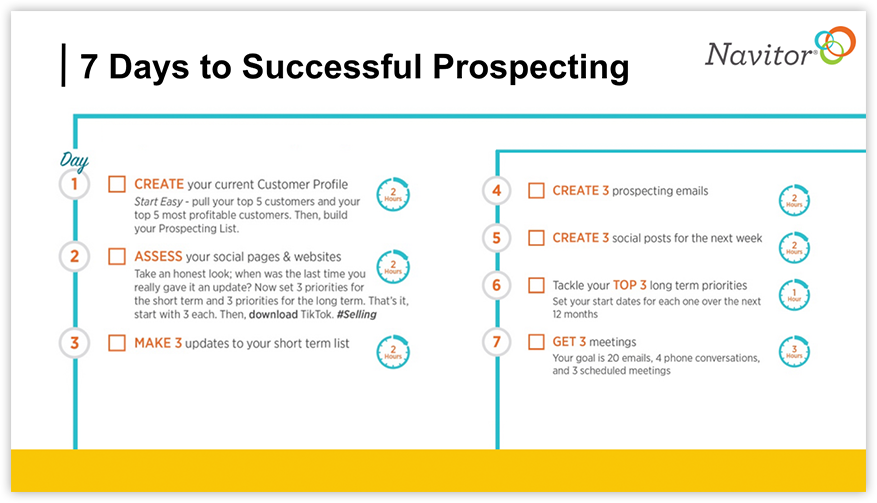
Start by reimagining your workday and dedicate at least two hours per day to your future success. Research shows 82% of top-performing salespeople spend four hours or more a day on selling. By prioritizing your time this way and blocking off 2-hour increments, you’re making an investment in you that will pay off big time. Once you’ve allocated time each day, commit to performing one of the seven actions below to turn into a lead-generating powerhouse. These can be done in an order that feels best to you, and remember, shoot for progress, not perfection.

Day 1 – Create your current customer profile
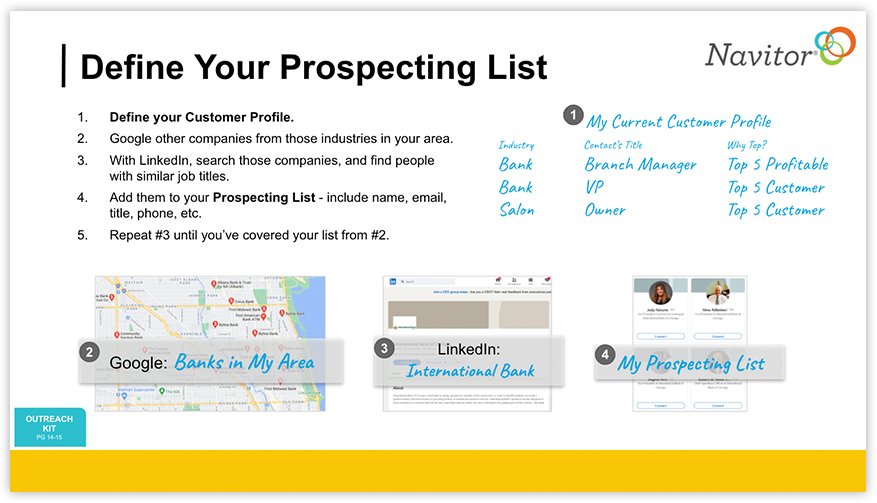
Start easy by pulling together a list of your top five customers and your top five most profitable customers. Creating an ideal customer profile negates the chances of wasting your time and efforts chasing unproductive leads. Use your customer profile to start building your ideal prospecting list. For example, if one of your top clients is in the banking industry and your contact is the Branch Manager, Google “banks in my area”. Jot down those search results. Then go to LinkedIn and search “Branch Manager” in your area and start searching for those specific banks. When you find that International Bank’s Branch Manager in your city is listed right there, add her to your prospecting list….and continue this process. Identifying 50-100 people for this list is a great start that will last you a couple of months.

Your prospecting list is probably one of the most important assets within your outreach. You’ll be sending great content soon; you need to make sure you’re targeting the right audience. LinkedIn is a first choice for top sellers to build a highly targeted B2B prospect list. The customizable search feature allows for plenty of filters to narrow down your search and find the most qualified prospects.

Day 2 – Assess your social pages & website
Take an honest look at your website and your social profiles. When was the last time you really gave each a much-needed update? Freshening your pages might not seem like a big deal, but don’t underestimate the importance of making updates in terms of looks, functionality, and content. With the majority of your potential customers spending more and more time online, regular and well-executed renovations can help your business grow. Set three priorities for the short term and three priorities for the long term. Check out some pro-tips in our Reaching New Audiences webinar on how you can start updating your website so it can be used as a selling tool.

Day 3 – Make three updates to your short-term list
Social media is one of the most important aspects of digital marketing, making it incredibly easy to spread the word about your products and service

s. Starting there is an easy and stress-free way to increase your business visibility fast. Your top priority can be maximizing your profile with a great (and current) profile picture and an i

mpactful cover photo. Consider free image sites like pexels for stunning cover photos. Add a call to action in your profiles that pushes traffic to your website, blog or newsletter and prompts more engagement, like “Follow”, “Discover More” or “Sign Up”. Your “About You” section should be engaging and creative, conveying your value proposition and the benefits of working with you.

Day 4 – Create three prospecting emails
B2B buyers check their email multiple times a day. As marketers, we can’t ignore the importance of a strong email marketing strategy.

Make sure you are using your company email address to add legitimacy to your pitch. Avoiding Gmail, Hotmail or AOL email addresses will keep your emails from automatically landing in junk mail folders. Including a great subject line and concise but personalized content will get and keep a reader’s attention. Communicate like a real person and show the benefits of your offering. And don’t forget a strong call to action. Check out sample subject lines, opening statements and email content ideas here.

Day 5 – Create three social posts for the next week
We hear a lot of distributors questioning the value of social media. And yes, social media can be frustrating because you can’t tie it directly to sales. But social drives awareness. Awareness leads to conversion. Some of the benefits of social media are:

  • Brand recognition
  • Increased website traffic
  • Enhanced SEO rankings
  • Marketplace awareness

Start by focusing your attention on one platform. We suggest LinkedIn because customers will often look for you there. Dedicating some time to this arguably most cost-effective marketing channel will improve brand awareness while you ramp up engagement and interaction. The most ideal times to post, along with the best types of content for LinkedIn, and what makes the perfect Facebook post can be found here.

Day 6 – Tackle your top three long-term priorities
Most of us fill our days with managing the endless tiny details without taking time to regularly step back and look at the bigger picture. Turning long-term goals into reality takes a clear, actionable plan. Some top priorities from distributors are: adding eCommerce to their website, adding more products to their website, and updating the look of their website.

For today, list your three long-term priorities, and when you’re going to start. Don’t worry about all the details today, just set your start dates for each one over the next 12 months. Book that in your calendar and that will be when you start to dedicate more time to these larger priorities. Schedule when and how long you’ll work toward your long-term goals.

Day 7 – Get three meetings
It takes on average 5-8 touches to land a meeting. A practical goal for today could be 20 emails, four phone conversations, and three scheduled meetings. Studies found 82% of buyers accept meetings with salespeople who reach out to them. Who knew? Use LinkedIn to find people in your network that are connected with your prospects. Some of your 20 emails that you’re sending today could be to current customers for referrals.

Phone calls help build that personal relationship more quickly than other methods of contact. We’ve compiled some stats, tips, and stellar phone prospecting best practices here.

In conclusion
The most valuable part of prospecting is your own time. And the math is simple:

More prospects = more chances to close a sale

Instead of saying “How can I prioritize prospecting?”, we challenge you to say “I am prioritizing the future of my company.” Every day is your chance to recommit to your future. We’re here to help walk you through your 7 Days to Successful Prospecting. With our support and innovations, you’ll be well on your way to finding better leads and converting more prospects into customers.

CBD and Cannabis Sales Start with Shelf Presence

Imagine you’re walking through a dispensary or a retail store that sells CBD. There’s definitely no shortage of new and interesting products to choose from on the shelves. How purchase decisions are made is part art, part science. Packaging plays a more important role in those decisions than you might think. It is a driving factor in determining what product you walk out of the store with. Since packaging is often a consumer’s first introduction to a product, it pays to be innovative and unique in order to stand out on a crowded shelf and get noticed.

The importance of product packaging is multi-faceted and can make all the difference in ensuring a great first impression and lasting brand loyalty. Here are a few tips and tricks for strategic product packaging:

Functionality
Keeping the product safe for its journey from production through distribution, and from store shelves to buyer’s homes is where it all starts. Preventing damage with a sturdy and reliable package is foundational, followed by convenience and ease of use. There are plenty of standard options with a wide range of weights to ensure functionality and convenience and also differentiate the packaging. Once fit-for-purpose and functionality are checked off, you can move into the more artistic points that attract customers and encourage them to buy the product.

Image
Packaging is the primary marketing medium in the cannabis industry, making first impressions everything. Buying decisions are influenced by how the packaging promotes and displays the product inside. On average, it takes only seven seconds to form a first impression. With such limited time, the best way to stand out on the shelf is with unique, high-quality, and creative packaging. This includes both printing and finishing methods that help the consumer perceive the value of the product and provide a great experience. We specialize in making the packaging more appealing and attractive while adhering to brand standards and necessary regulations.

Brand Awareness
Product packaging is not just a reflection of the product inside, but the brand as a whole. Innovative packaging differentiates brands. To influence buying and create brand awareness, it’s important that consumers can easily determine what the product is and make associations with the brand. Combining exceptional printing processes with high-quality materials yields a more memorable experience with a brand. Choosing the best substrates and impactful, high-resolution images on the package can help boost brand awareness.

Special Touches
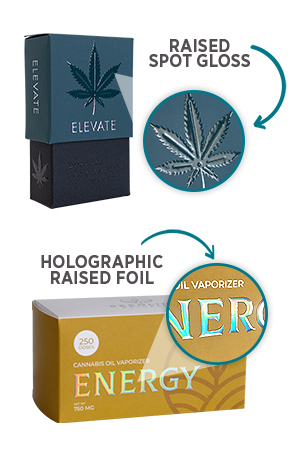
Custom finishes and coatings add uniqueness and help step up shelf visibility. They highlight design elements, elevate the tactile experience and add dimension. Processes like debossing, embossing, foil stamping, spot color, and intricate die-cutting transform the appearance of products on the shelf. Finishing extras such as UV gloss coating, spot UV, soft-touch lamination, aqueous satin, and raised UV give packages a snazzy, polished look.

Integrated Elements
An effective way to set products apart and help them stand out on the shelf is through creative integration with additional elements including matching bottle labels, inserts, and hangtags around the packaging.

Collaboration with Navitor, your trusted packaging expert, is key to making your product stand out on the shelf. Our innovations and ideations will bring your vision to life. Check out Packaging now.

The Holiday Shopping Season Redefined

It’s snow joke – we are in for a holiday season unlike any other we’ve been through. The traditional merriment we look forward to each year involves eating, drinking, and singing together in a cozy room … all among the highest risk scenarios for transmitting viruses. It’s pretty unlikely we’ll see shoppers lined up before sunrise for Black Friday deals, or rushing to crowded stores for last-minute gift buying. No matter the circumstances, this is the time of year when retailers and other businesses start to mull over their holiday plans and prepare for what promises to be an unprecedented holiday season. How will the pandemic affect what has traditionally been retailers’ busiest time of year? Rest assured, we have some ideas around what can be expected. If unprepared, yule be sorry … but by preparing for what’s to come and offering innovative ideas and options, yule be sleighing it.

Where the holiday dollars will go
Money typically spent on heavily attended parties and festive gatherings, travel, and enormous grocery bills for huge dinners instead will go toward gift-giving, albeit with some differences. Experiential gifts like concert and event tickets, restaurant gift cards, and massage certificates are out, while popular merchandise categories – things you can hold in your hands (after sanitizing, of course) – are in.

Shoppers starting early
Gift-givers will be coming out of quarantine as holiday shopping season starts earlier than normal. Opting to shop during less volume-heavy times, consumers are likely to buy sooner rather than later in order to avoid crowds and to make sure the items on their lists are even available. From a shopper’s standpoint, one of the biggest challenges during the pandemic has been product availability. Supply chains are compromised and inventory is low. Making matters worse, deliveries take longer than normal because as the volume increases, shipping delays only get worse. To avoid out-of-stocks and account for anticipated shipping delays, shoppers will be starting early.

Business gift-giving
Businesses reaching out to customers and employees at the holidays this year will opt for cards and gifts as alternatives to dinners and parties. In order to show their gratitude and appreciation for the loyalty of their customers and employees over the past year, corporate giving will likely be at an all-time high. Branded promotional products are sure to be in high demand as businesses manage their customer and employee gift-giving from a distance.

Retail shopping holiday makeover
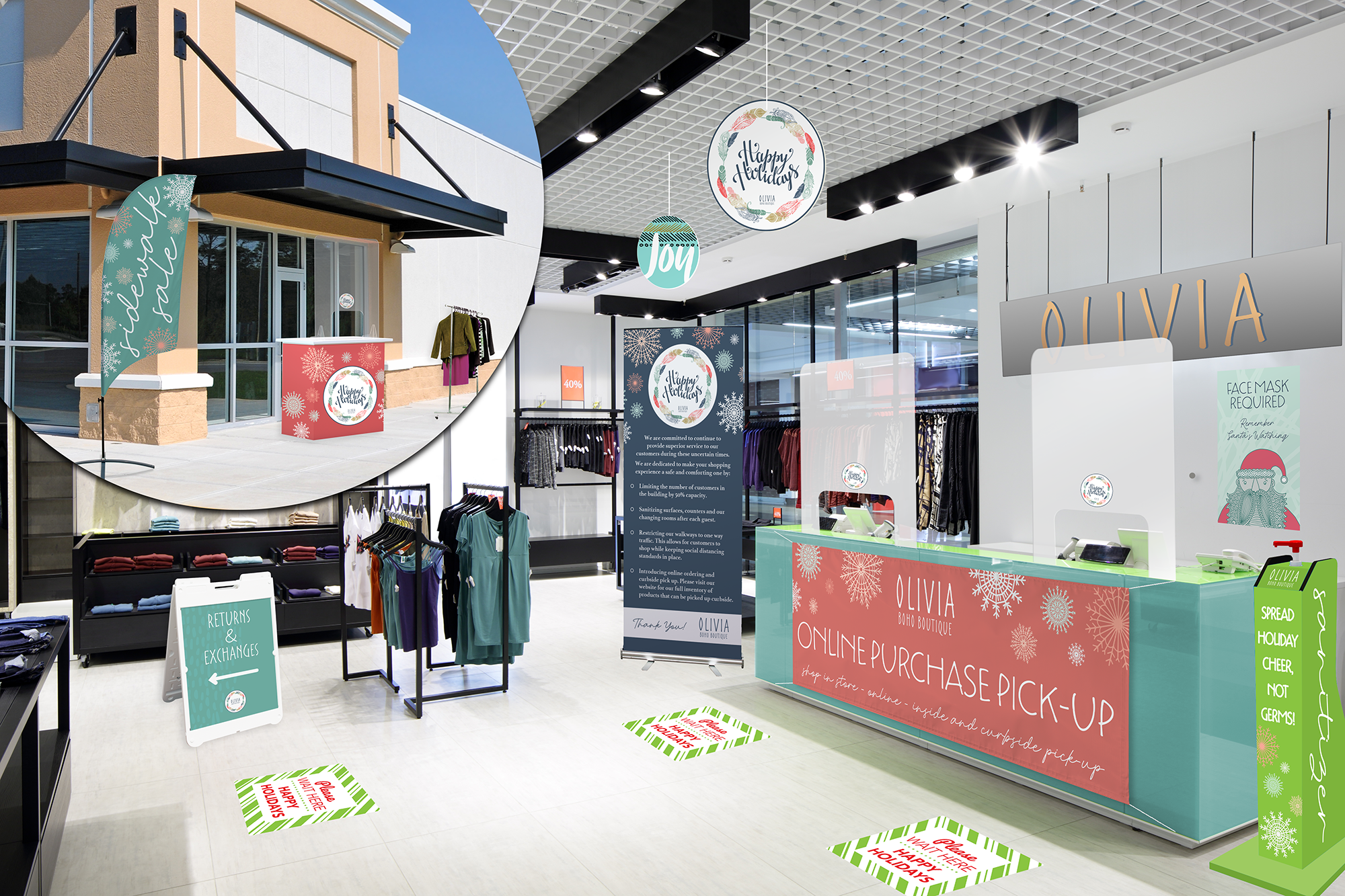
Without question, COVID-19 has transformed the retail shopping experience. The holiday shopping season will look quite different this year as retailers find themselves mired in the coronavirus. Here are some of the changes in store for us this year:

  • No more Black Friday lines – large retailers like Target, Macy’s, Foot Locker, JCPenney, Bed Bath & Beyond, and Best Buy have all announced that they’ll close stores on Black Friday
  • Buy online, pick up in-store – COVID-19 pushed shoppers online early in the pandemic, and not only has that trend not slowed, but it will also pick up speed in the coming weeks
  • Still social distancing – but in a more festive manner – soon all those banners, signs, floor and window decals will look very merry
  • Pop-up sales outside – expect to see outdoor pop-up shops in cities with climates that can accommodate them
  • Extra sanitation – safeguarding the health of staff and shoppers will require sanitation stations and signage throughout stores, especially near return counters
  • Curbside pickup – emerged early this year, and expectations among shoppers are that this option will be made available across all retail brands
  • Heavy communication and signage – to cut down the need for face-to-face conversations, directional signs, infographics, posters, and decals will be used to inform shoppers and direct traffic flow
  • More gift buying – with travel money squashed and big gathering spend down, that means a bigger bankroll for gifts

Stand-out products
With all the social and shopping changes brought about by the pandemic, there are still innovative products in high demand. Some of the top holiday options include calendars, greeting cards, glitter stock items, custom packaging, promotional products, custom gift wrap, labels, face coverings, holiday signage, direct mail, and much more. Communication and information exchange are not the only things going contactless this holiday season: Expressing gratitude and thanks will be done through gift-giving and showing appreciation without the typical holiday get-togethers.

The takeaway
To really make an impact this year, make sure you’re giving your customers the information they need – and preparing early is critical. Have your stocking stuffed full of ideas your customers will love (from head to mistletoe). Even though most hugs will be saved until next year, we’re still here to help you navigate the 2020 Holiday Season. We’re your go-to resource with ideas and innovative ways to work through the challenges you’re facing and uncover the opportunities this shopping season brings. For some great options, check out our online booklet Reinventing Holiday Traditions in the Next Normal.

Are you ready to help your customers get through the cold and flu season?

What a remarkable and unprecedented year it has been. As 2020 comes to a close and we head into cold and flu season, it is unclear whether COVID-19 will persist at its current pace, if there will be an onslaught of smaller outbreaks, or if a larger second wave is on the horizon. To further compound matters, flu season is right around the corner, generally lasting through January. This overlap has many concerned – are we facing a double whammy? Or will social distancing and our new hygiene habits stave off the spread of influenza this year? Either way, we are in for an interesting season, and because this flu season may be quite daunting, there will likely be a lot more customers looking for products to prepare for it.

Time to have the conversations
We may be looking at a different and broader purchasing season this year as businesses gear up for flu season amid a pandemic. Because of that, it is high time to discuss readiness options with your customers. Checking in with them and offering products and solutions to help them prepare for what’s to come may ultimately lessen the impact, one community at a time.

Topics to get ready for
Sure to be front and center this winter are the differences between COVID-19 and the flu, and COVID-19 and the common cold. Posters, signage, decals, postcards, flyers, and envelopes will lend a hand in informing the public about what’s what. Similarly, many will need to communicate flu shot information, including companies offering flu shot programs to their employees. All public access areas continue to require social distancing products, and will certainly be emphasizing the importance of hygiene and sanitizing. Additionally, with a second potential shutdown looming, retail stores trying to lessen stockpiling will need signs, banners, and decals reminding folks to take a limited number of essential items. Nonprofits, governments, and other agencies will need products and communications informing people of where they can get ahold of emergency services and supplies. As hospitals and clinics approach maximum capacity, their need for materials increases as patients increase. There is also a new topic on the block: screening supplies. No more rushing off to work or rushing kids off to school with the sniffles – there will be more hesitation, more mindfulness, and symptom screening.

Who’s buying?
The current circumstances are opening new areas of “who’s buying” and “who’s interested.” Undoubtedly, the employers in the community, retail shops and stores, governments, nonprofits, schools, healthcare, manufacturers, banks, insurance, financial institutions, and more will need readiness products and communications solutions to help gear up for the next five months.

How can you help?
Start having conversations with everybody you can think of. No one is exempt from what the world is experiencing right now. Helping your customers and prospects solve their challenges centered around informing, directing, notifying, and protecting makes you an essential piece of the puzzle. We have created templates with specific cold and flu messaging that may help get some ideas in front of your customers as well.

Next steps
Are you ready? We are. And we are here for you. Navitor has a plethora of options, ideas, and support, and offers a free content page for distributors like you. We have over 100 pages of ideas, products, text, and imagery that you can use as your own. The solutions benefit top industries in need of new, important and often urgent messaging. Navitor members have access to exclusive, more detailed materials such as a social toolkit for each of today’s most predominant industries, customizable eBooklets where you can add your own name or branding, or even the actual slides to the webinars we produce complete with links and additional resources you can use with your customers.

Voting and Polling Place Safety in the Midst of a Pandemic

No question, voting will look different this year than in the past. Election safety needs have changed dramatically due to COVID-19. Some people are apprehensive about voting in person. Understandably, Americans are looking at all the different ways they can vote in this coming election. Voters and poll workers alike need assurances they can vote and volunteer safely. Putting voters and poll workers at ease with information and safe polling places calms fears and streamlines the voting process. This year you can expect to find more directional signage guiding the traffic flow in and out of polling places via eye-catching wall decals, floor decals, A-Frame signs, sail signs, and stencils.

Communication to voters
In the weeks leading up to the election — this year more than ever — reminding voters where, when, and how they can cast their ballot is necessary. There are many questions on the minds of a large majority of voters and direct mail is a tried-and-true way to communicate with such a mass audience. Not only do politicians rely on direct mail to sway voter opinion, election, and campaign offices trust its reliability to reach voters and encourage election participation. Contactless communication tactics get the message across from a socially distant and safe spot such as door hangers, window decals, and bumper stickers. Large format banners and sail signs announcing early voting and ballot drop off locations draw the attention of voters.

Understanding all the options
Thankfully there’s more than one way to cast a ballot this fall. Each state plays by their own rules, but most include a registration process, offer early voting, absentee ballots, in-person voting, and drop-off voting. USA.gov’s navigation-friendly site is a reliable resource for answers to common and general questions about voting in the United States. To get specific on what options each state offers, FiveThirtyEight has compiled and colorfully illustrated a frequently-updated state-by-state guide to voting in the age of COVID-19. Posters with these options in local libraries, government offices, and recreational facilities will spark higher voter turnout in the community.

Absentee and mail-in voting
The system has its 15 minutes of fame this fall is absentee voting. The terms absentee voting and mail-in voting are often used interchangeably. Absentee ballots refer to ballots that are requested and then mailed when a person can’t vote in person. Mail-in ballots refer to the ballots in the context of policies that allow people to vote by mail. However, some election officials have started using the term “mail-in ballots” or “vote by mail” as states expand absentee ballot eligibility during the pandemic to include people who aren’t actually absent from their precinct at the time of voting. At least 35 states have changed their mail-in absentee voting policies, allowing all voters to apply for an absentee ballot in order to mitigate the spread of COVID-19. Candidates and local governments are using direct mail to get the word out on a mass scale to inform people of the options available to them.

Ballot drop-off
Some states and localities offer ballot drop box locations where voters can drop off absentee and mail-in ballots in sealed and signed envelopes. Some supervised, others unsupervised with security cameras, most have requirements for where they must be located, how many a county must-have, the hours they must be available, and specific security standards. Residents can find useful voter information for their state and region at U.S. Vote Foundation. Each drop-off voting location should be clearly marked with signs and banners giving arriving voters clear instructions throughout the process.

In-person voting
Of course, there will be those dedicated and determined voters that either enjoy the process and prefer to partake on-site, or question whether their vote will be counted if it isn’t cast in-person. For the legion of in-person voters, attracting them to and informing them at the polling place will be essential this election season.

  • Outside spaces
    Attracting passersby to polling places will require highly visible, colorful, and patriotic signage. If the polling place offers curbside ballot drop off, they’ll need to make sure voters know about it. Signs will inform, direct, and keep everyone safe.
  • Once voters arrive
    Areas will require clear indicators where lines form and where to drop off ballots. The demand for extremely noticeable elements for directing and informing will call for portable and durable outdoor signage as well as indoor signage.
  • Inside the polling place
    Safeguarding the health of all who enter the building is critical, and positioning kiosks and barriers will protect both volunteers and voters. Posting CDC guidelines for social distancing and handwashing protocol as well as offering complimentary hand sanitizer stations are a certainty this year. The use of floor decals, retractable banner stands, wall decals, and window decals will inform and direct voters of the safest manner in which to move about the space.
  • Post ballot casting
    Keeping the crowd moving, minimizing exposure, and expediting voters through their process with full knowledge of where to go will require items like A-Frame signs, directional decals, and sail signs to help voters find the exit.

COVID-19 has added new twists to an already complicated election year. Voter turnout could be abysmal given social distancing constraints and other pandemic-driven restrictions. In order to understand all the voting options and have assurance that it is safe to cast their vote this year, voters need communication, communication, and more communication. We’re dedicated to providing health and safety readiness products that support communication, inform voters, and prepare polling places leading up to and through Election Day. For election season safety product ideas, follow this link to polling place health and safety readiness products in the age of coronavirus.

Custom Letterhead and Envelopes: A Perfect Pair

When consumers go out to their mailbox, what they see can make a big difference in whether their mail gets opened. Polished, branded envelopes and letterhead are an essential way to add your customer’s brand to every mailing.

Why Coordinate?
The first reason your customers probably think of for buying letterhead and envelopes together is to create a complete stationery suite, and that’s a great place to start. Stationery envelopes are meant to coordinate with your customer’s letterhead order, which means that they can easily match the stock and print to create a stationery look with the utmost professionalism.

And coordinating stationery pieces does create a more professional look. It will make your customer’s messaging look put-together, and that can help consumers see your customer as more professional.

Beyond Stationery
Envelopes aren’t just the finishing touch for your customer’s stationery suite, though. They can also bring your customer’s brand to every mailing they send out. Stationery envelopes are just one part of a complete coordinated print set for your customer’s business, and bringing it all together can help them look as professional as possible to consumers.

Business envelopes printed with your customer’s logo are a great way to bring their brand to everyday mailings like invoices and account statements even before the envelope is opened. Even better, consumers will know exactly who sent their mail, so they’ll know at a glance who the mailing is from. This makes invoices and account statements more noticeable.

And if your customer has a larger mailing to send out, envelopes can bring their brand to catalogs, large booklets, paperwork packets, and more. Not only are these pieces branded, but they can also help protect these larger pieces better than sending them as a self-mailer will.

Which are your customers’ favorite envelopes? Leave us a comment below to tell us more about how your customers use envelopes in their business.

The Business of Badges: How You and Your Customers Can Both Benefit

Almost every industry uses ID badges. You see them on bank tellers, store clerks hotel staff and bartenders. Flight attendants, nurses, and even realtors commonly wear name badges.

Badges provide an opportunity to reinforce a company’s brand while also lending a sense of professionalism. Knowing someone’s name also gives customers a sense of familiarity. And badges encourage employees to go the extra mile, knowing customers might mention them by name.

We offer an extensive selection of name badges to suit any industry.

New Offerings for 2020
Our badge line now includes two new options:

  • Full color printing on alder wood for a natural, aesthetic
  • Sublimation printing on silver or white aluminum for a more industrial feel

Reusable Name Badges
High turnover industries like retail and hospitality particularly appreciate our reusable badges. The ability to use the badges for different employees reduces costs and waste.
Our three reusable name badge options include a full color imprint with different functions:

  • Chalkboard (used with chalk or chalk marker),
  • Plastic (used with a dry erase marker)
  • Window-badge (used with customer-supplied printed name)

Engraved Name Badges
Engraved badges offer supreme durability. Choose from plastic, metal (Flexibrass), or wood. Engraving is permanent and long lasting.

Full Color Print & Sublimation Name Badges
These specialized printing processes can be used with plastic, wood, metal or acrylic for a polished appearance. These badges are ideal for customers with intricate or colorful logos.

Photo ID Badges
Custom ID badges are beneficial to workplaces where additional security is needed. They help distinguish between employees and non-employees.

Name badges are a useful tool for all types of businesses. And any time is a good time to promote them. Badges are a great way for businesses to accentuate their brand and make employees more approachable to customers. Let us know what kind of badges you use in the comments below!